
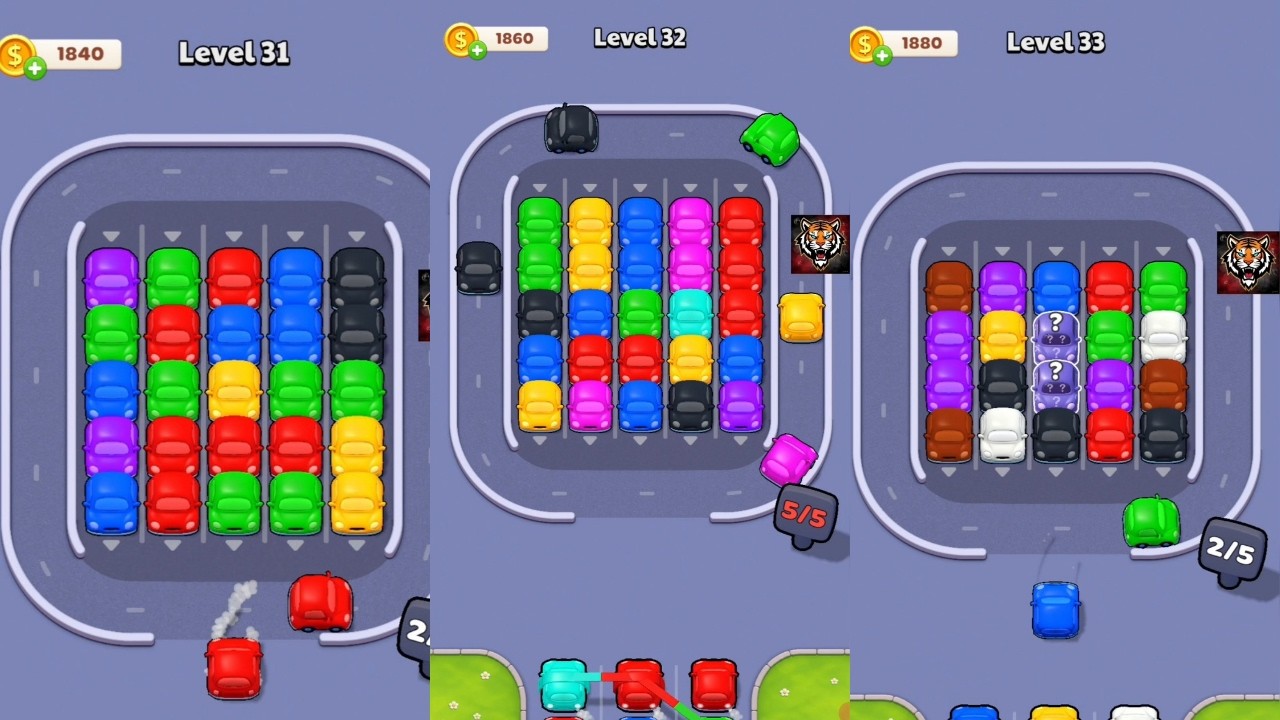
To clear levels 31 through 40 in Parking Loop, follow a strict outside-in clearance sequence: dispatch outer perimeter vehicles that have unobstructed exits before attempting to move trapped interior cars into the main loop. Tapping vehicles from the outside edge inward creates the turning space and buffer zones needed to prevent collisions at intersection throats.
Stage-by-Stage Clearance Priorities
Each cluster of stages in this set introduces distinct pathing obstacles and spatial restrictions.
| Stage Group | Primary Hazard | Priority Target | Clear Strategy |
|---|---|---|---|
| Levels 31–33 | Opposing stall alignments | Outermost edge vehicles | Trace turning arcs to ensure front bumpers clear adjacent stalls |
| Levels 34–35 | Constricted perimeter loop | Parallel perimeter cars | Remove outer keystone vehicles first to establish flow space |
| Levels 36–38 | Perpendicular cross-traffic | Corner units with direct paths | Stagger releases across shared intersection junctions |
| Levels 39–40 | Multi-layered gridlock | Outer gate blockers | Unravel concentric layers sequentially from exit gates inward |
Levels 31–33: Opposing Stalls and Turning Arcs
In levels 31 to 33, stalls face alternating directions, often placing opposing bumpers in direct conflict. Before tapping any vehicle, trace its projected turning path along the stall lines. A car parked beside an occupied stall can clip adjacent fenders as its nose swings into the lane. Clear the outermost edge vehicles first to expand the turning clearance for remaining rows.
Levels 34–35: Keystone Vehicles and Active Flow
Levels 34 and 35 feature perimeter circuits where outer loop traffic constricts central exits. Look for the "keystone" car angled parallel to the main exit path on the perimeter. Dispatching this specific vehicle relieves pressure on the outer circuit. Once this bypass lane is open, interior vehicles have enough room to swing out without stalling mid-turn.
Levels 36–38: Crossing Corridors and Turn Delays
Stages 36 through 38 incorporate intersecting routes and central islands where vehicles must cross active lanes perpendicular to their stalls. Releasing vehicles out of sequence creates blockades at shared junction throats.
- Identify cars positioned on corners that have direct, uncrossed exits to the outer ring and dispatch them first.
- In Level 38, cars making sharp right-angle turns immediately upon exit briefly widen their collision footprint while executing the turn animation. Wait until a turning car straightens out before sending another vehicle through that same junction.
Levels 39–40: Multi-Layered Gate Clearance
Levels 39 and 40 feature high-density layouts where trapped cars point toward interim holding points rather than open exits.
- Clear the bypass gate: In Level 39's spiral layout, remove the car nearest the outer exit gate, followed by the flanking units securing its boundary.
- Unravel the spiral inward: Once the perimeter barrier is dismantled, release the inner concentric rings sequentially.
- Open staging paths in Level 40: Several vehicles point into dead-end zones. Clear outer corner anchors first to convert those dead ends into usable staging buffers, then feed the center vehicles into the perimeter loop one at a time.
Merge Window and Acceleration Timing
Tapping a car the moment an opening appears in the moving loop often triggers a crash. Stationary vehicles do not match loop speed instantly; they require a brief startup window to accelerate out of the stall.
- Use the trailing-gap technique: Release a parked vehicle precisely when the rear bumper of a circulating car passes your stall's exit line. This maximizes the gap behind it and gives your launching car sufficient time to reach full circuit speed.
- Avoid simultaneous releases: Never launch two cars simultaneously if their paths converge within three car lengths.
- Maintain release cadence: Keep a steady pause of roughly one second between launches during tight sequences to prevent tailgating collisions at exit corners.
Free Parking Loop Codes
Current active codes and how to redeem them.

James Brown
James focuses on Android gaming on PC, emulator setup, controls, performance tuning, and practical troubleshooting for longer play sessions.
COMMUNITY
Player Comments
139 players commented on this guide.
The explanation is clear, especially for beginners.
This guide answered the exact question I had.
Good guide for Parking Loop players. The strategy part was useful.
I wish I had read this before upgrading the wrong thing.