
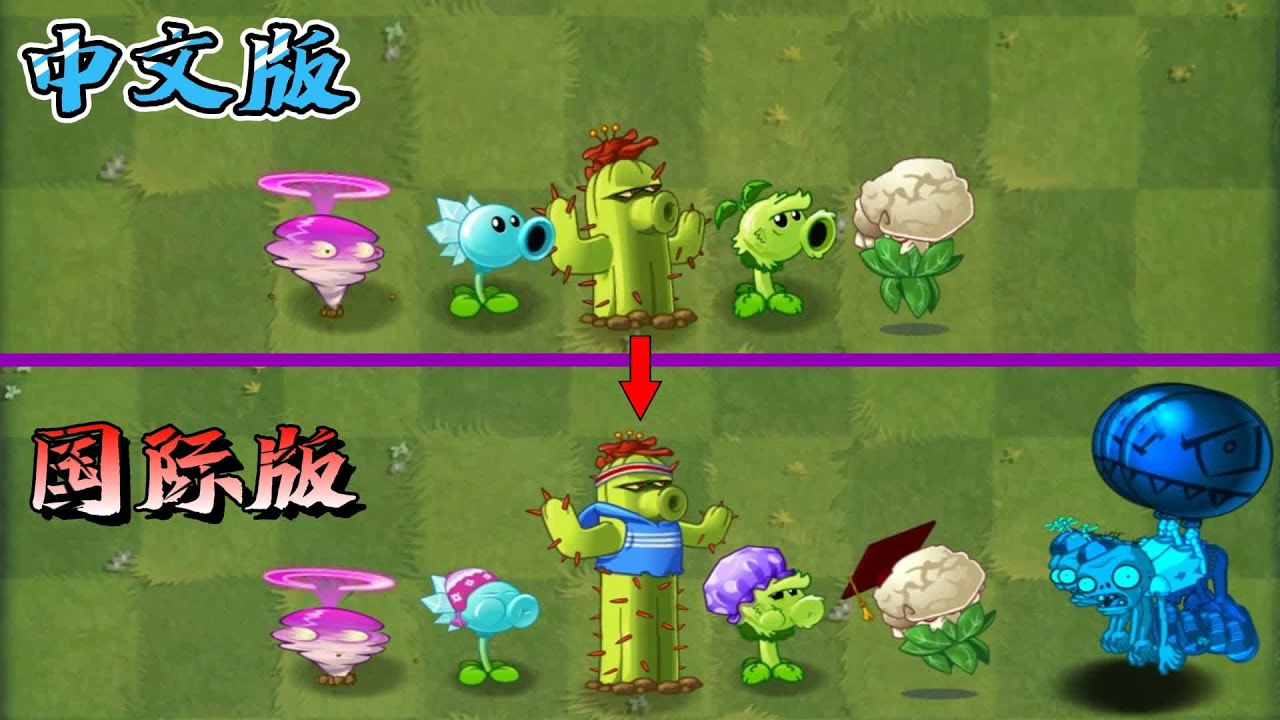
Identical plants perform differently between the International and Chinese editions of Plants vs. Zombies™ 2 because each version uses distinct progression curves, combat formulas, and secondary equipment systems. In the International edition, plants scale through linear numerical upgrades over 10 to 20 levels and into Mastery without altering their core attack types. In the Chinese edition, plants follow a five-tier evolution system, face level-gated tier suppression from zombies, and gain active combat passives from costumes and equipment.
Before applying strategies or spending resources across versions, evaluate how these four core systems change each plant's role.
1. Linear Leveling vs. the 5-Tier Progression Ladder
In the International edition, upgrading a plant increases baseline statistics—such as higher damage, reduced sun cost, and faster recharge—while the plant's core behavior remains identical from Level 1 to Level 10 or 20.
The Chinese edition locks plants behind a five-tier ladder powered by gold and specific puzzle pieces. Reaching higher tiers directly alters attack behaviors:
- Tier 1: Base performance, often tuned weaker than the International Level 1 baseline.
- Tiers 2 and 3: Adds passive traits, such as multi-strike chances, projectile alterations, or critical hits.
- Tier 4: Grants a percentage chance to trigger the plant's Plant Food effect instantly upon being planted, without consuming stored Plant Food.
- Tier 5: Reworks the plant's attack pattern completely, adding elemental effects, area-of-effect shockwaves, or unique projectile variants.
2. Combat Scaling and Tier Suppression
In the International edition, utility effects such as knockback, stuns, and freezes trigger consistently regardless of the target zombie's level. Zombie levels scale health and movement speed, but baseline plant mechanics do not turn off.
The Chinese edition applies a strict tier check between plants and zombies:
| Combat Factor | International Edition | Chinese Edition |
|---|---|---|
| Crowd Control | Knocks back or stuns reliably at any level | Fails or suffers severe resistance against higher-tier zombies |
| Damage Against Armor | Deals consistent base damage minus armor health | Lower-tier plants suffer heavy damage penalties against Tier 3–4 targets |
| Plant Food Triggering | Requires manual Plant Food or Tile Turnip tiles | Can trigger automatically upon planting via Tier 4 passives |
| Endgame Scaling | Mastery levels provide damage pierce and bonus boosts | Tier 5 upgrades transform projectile types and hit properties |
Because of tier suppression, an iconic utility defender like Primal Peashooter controls lanes consistently across International Adventure and Arena modes. In the Chinese version, a low-tier Primal Peashooter cannot reliably knock back Tier 3 or Tier 4 zombies, rendering it ineffective until upgraded.
3. Costume and Equipment Mechanics
In the International edition, costumes are purely cosmetic items obtained through the shop, events, or Piñata parties. A plant's Plant Food effect remains functionally unchanged by what it wears.
The Chinese edition treats costumes and gear as active combat gear:
- Altered Plant Food: Equipping a costume in the Chinese version adds secondary effects to the ultimate attack, such as extra explosions, projectile splits, or lingering floor hazard damage.
- Bonus Resource Generation: Specific costumes generate sun, drop coins, or clear debuffs when Plant Food triggers.
- Pendants and Accessories: The Chinese edition includes equipment slots for items like pendants, which lower planting costs or boost specific elemental damage types independent of plant levels.
4. Stat and Role Adjustments on Shared Plants
Because each game is balanced around different progression math, plants do not hold the same relative power rankings across both rosters:
- Primal Peashooter: An elite lane-control unit in the International edition due to guaranteed knockback; requires high-tier investment in the Chinese edition to bypass tier suppression resistance.
- Red Stinger: In the International edition, its offensive output depends on placement across the back three columns. The Chinese edition alters these lane boundaries and unlocks extra defensive shielding at higher tiers.
- Laser Bean: Acts as a standard non-deflectable piercing attacker across International levels; in the Chinese meta, it faces steep damage penalties against high-tier armor without substantial investment.
- Early Melee Defenses (Bonk Choy, Snapdragon): Clear lanes reliably in early International worlds, but struggle against fast Chinese-edition bucketheads without unlocking Tier 2 and Tier 3 dodge or counter mechanics.
How to Adapt Your Strategy Between Versions
When switching between clients or evaluating strategy guides, take these actions:
- Verify the client source: Check whether footage or guides showcase tier numbers (Chinese) or linear numeric levels and Mastery icons (International) before copying a build.
- Never rely on base-tier utility in the Chinese edition: Do not deploy low-tier crowd-control plants against high-tier zombie waves expecting International knockback or stun consistency.
- Prioritize puzzle pieces for primary lane holders: In the Chinese version, concentrate puzzle pieces to push your primary damage dealers to at least Tier 4 for auto-Plant Food triggers before diversifying your roster.
- Acquire functional costumes deliberately: Treat costumes in the Chinese edition as essential equipment upgrades for your core roster rather than cosmetic collectibles.

Free Plants vs. Zombies™ 2 Codes
Current active codes and how to redeem them.

Sarah Williams
Sarah specializes in RPG and collection games, explaining team building, character growth, and beginner-friendly ways to avoid expensive early mistakes.
COMMUNITY
Player Comments
142 players commented on this guide.
Can you add more details about strategy in a future update?
Nice guide. I am checking the other Plants vs. Zombies™ 2 articles next.
I tried this today and it worked better than my old setup.
This guide answered the exact question I had.