
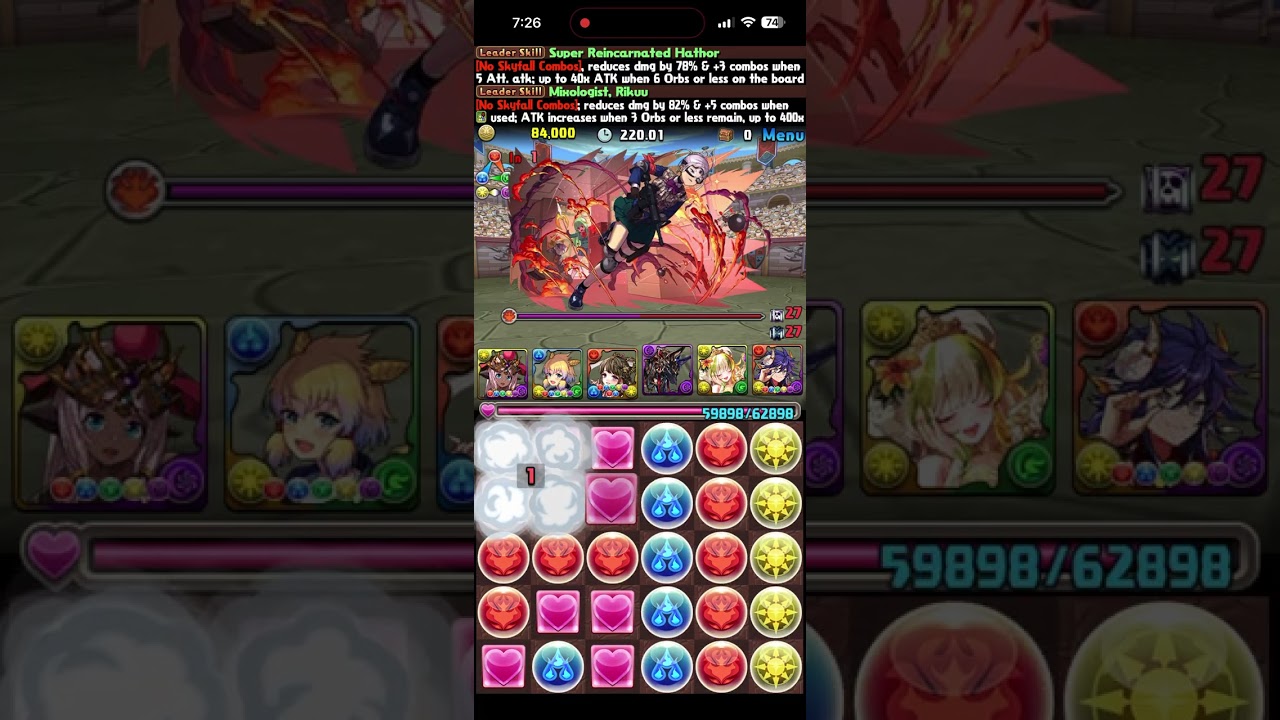
To achieve a top-bracket score of 174,348 in the Puzzle & Dragons Summer Exercise Tournament, clear every floor in a single turn, keep average movement time under four seconds, and execute a structured board solve on the final boss. Because the tournament ranking system heavily penalizes wasted seconds and extra turns, hesitation or dropped orbs will immediately take a run out of crown contention.
Scoring System Breakdown
Reaching a 174K benchmark requires balancing clear speed against combo averages while avoiding turn deductions. Ranking points are determined by remaining time, combo output, damage milestones, and turn count efficiency.
| Scoring Factor | Point Calculation | Execution Priority |
|---|---|---|
| Time Remaining | +500 points per second | Highest: Minimize movement time and avoid skill animations |
| Average Combos | +5,000 points per combo | High: Form natural edge matches without excessive looping |
| Maximum Damage | Up to +10,000 points | Moderate: Reach damage cap via primary attribute burst |
| Excess Turns | -1,000 points per extra turn | Zero tolerance: Every floor must be cleared in one turn |
Because an extra turn incurs a -1,000 point penalty alongside the loss of seconds from the timer, taking two turns on any floor invalidates a high-score attempt.
Early Floor Pacing and Movement Optimization
Maximizing the time remaining bonus requires clearing intermediate floors using natural boards rather than cycling active skills. Active skill animations consume clock time without awarding bonus points, so activate skills only when a board completely lacks necessary attacking colors.
- Scan before touching: Identify pre-paired clusters and border orbs before initiating movement to reduce path length across the 6x5 board.
- Pack the edges: Assemble horizontal or vertical matches directly against the outer borders first. Keeping the center clear reduces diagonal maneuvers and prevents accidental orb displacement.
- Control combo length: Rely on manual perimeter matches rather than relying on skyfall cascades, which consume clock time through extended animations.
- Limit move time: Keep active orb manipulation under four seconds per floor to preserve the clear clock.
Boss Floor Solving Sequence
The final boss represents the primary choke point of the Summer Exercise Tournament. Failing to meet damage thresholds or dropping combos on this stage wastes the accumulated time bonus from earlier floors.
Follow this five-step sequence upon entering the boss floor:
- Verify orb counts: Check natural board distribution for primary offensive colors before touching an orb.
- Find perimeter pairs: Locate edge and corner clusters to map the shortest path for initial matches.
- Anchor base shapes: Form required geometric patterns, such as Two-Pronged Attacks or box shapes, along the bottom corners first.
- Cascade upper rows: Route remaining colors through the side columns and top edge to complete combos without crossing back through solved sections.
- Release cleanly: Complete the final match away from corner intersections to prevent incomplete alignments.
Taking a brief half-second pause upon entering the boss floor to lock in the starting orb and route avoids mechanical drops that cause wipeouts.
Run Reset Benchmarks
Because tournament attempts require stamina and precise execution, abandon runs that fall below crown pace rather than playing them to completion.
| Metric | Target Pace (174K+) | Reset Condition |
|---|---|---|
| Floor Turns | Exactly 1 turn per floor | Any floor requiring a 2nd turn |
| Move Duration | Under 4.0 seconds per floor | Stalls or pathing exceeding 6 seconds |
| Boss Board | Immediate anchor and full solve | Incomplete shapes, missed kills, or dropped orbs |
| Skill Usage | Zero unplanned activations | Active skill used to fix minor board imbalance |
If a floor fails to sweep on the initial attack or an orb drops mid-solve on the boss, exit the dungeon immediately to restart.
Free Puzzle & Dragons Codes
Current active codes and how to redeem them.

Emily Johnson
Emily writes practical mobile strategy guides with a focus on resource planning, base progression, and the early decisions that shape a long-term account.
COMMUNITY
Player Comments
67 players commented on this guide.
I wish I had read this before upgrading the wrong thing.
The tips are practical and easy to follow.
This guide answered the exact question I had.
The explanation is clear, especially for beginners.