
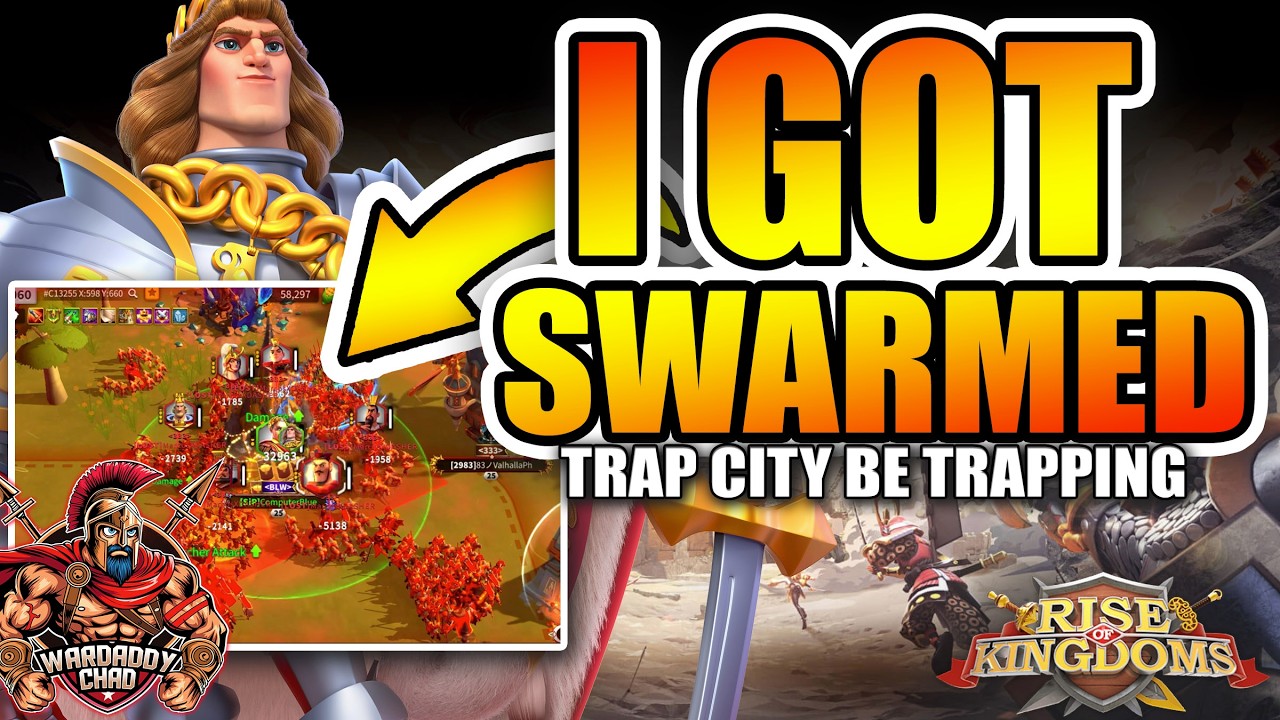
In Rise of Kingdoms, the "Trap City" is an advanced defensive maneuver designed to turn your base into a tactical anchor. Rather than avoiding conflict, a Trap City deliberately baits enemy players into overcommitting their forces. By creating the illusion of a vulnerable target, you lure attackers into a "swarm"—a scenario where they converge on your city, allowing your alliance to force inefficient trades, drain enemy speed-ups, and create openings for strategic counter-attacks elsewhere on the map.
Executing this strategy requires more than just high-power commanders; it demands precise coordination, deep knowledge of game mechanics, and a willingness to manage massive hospital bills.
Understanding the Trap City Concept
A Trap City functions as a strategic "lightning rod." The goal is to manipulate opponent psychology. Players in Rise of Kingdoms are often hunting for quick Kill Points (KP) or attempting to clear territory for an objective. When they see a solo city sitting deep within a contested zone, their instinct is to swarm it for an easy victory.
The "trap" is that you aren't fighting alone. You are backed by the full weight of your alliance's reinforcement capacity. While the enemy focuses their attention, troop count, and action points on your walls, the rest of your alliance is free to capture objectives, flank reinforcements, or dismantle the enemy's supply lines. You win by forcing the enemy to trade their high-value troops for your garrison's defensive efficiency.
The Prerequisites for a Successful Trap
Before attempting to bait a swarm, you must ensure you meet the baseline requirements for your specific Kingdom vs. Kingdom (KvK) season.
- Garrison Commanders: You need maxed-out garrison commanders with appropriate talent trees (typically focused on defense and garrison stats). If your commanders are not specialized for city defense, you will be burned quickly, and the "trap" will become a disaster.
- Equipment Quality: Your garrison commander should be equipped with gear that boosts health and defense. Since swarms focus on total damage output, your ability to mitigate that damage is more important than your ability to deal it.
- Medical Capacity: You must have a massive stockpile of resources and speed-ups. A Trap City is an expensive endeavor. If your hospital fills up and you cannot heal, your city will burn, and you will lose your troops permanently.
- Alliance Coordination: Never attempt this solo. You need a dedicated "reinforcement team" from your alliance ready to fill your city the moment a slot opens up.
Positioning for Maximum Tactical Impact
Placement is everything. A Trap City is useless if it is too far from your alliance territory.
- Chokepoints: Position your city in high-traffic areas near mountain passes, ruins, or altars. By blocking a narrow path, you force the enemy to interact with you if they want to proceed.
- Territorial Tethering: Ensure your city is within range of your alliance's flag network. This allows for faster reinforcements and provides the protection of your alliance's territory bonuses.
- The "Vulnerable" Bait: Position your city just slightly outside of the main cluster of your alliance's cities. This makes it look like an isolated, easy target for an enemy scout or a lone attacker.
Managing the Swarm: The Mechanics of the Trade
When the swarm begins, you are no longer playing a standard real-time strategy game; you are playing a game of resource management.
The Reinforcement Loop
The most critical part of a Trap City is the "garrison refresh." When your city is swarmed, your garrison troop count will drop rapidly. Your alliance members must click the "reinforce" button constantly. If the garrison count hits zero, the city is considered "defeated" in that instance, and the enemy can teleport away or move on. Keep the city alive, and the enemy remains stuck in combat.
Measuring Trade Efficiency
Monitor your Battle Reports constantly. The "Trade Ratio" is the golden metric.
- Positive Trade: You lose fewer troops (or lower-tier troops) than the enemy loses. This is the desired outcome.
- Negative Trade: The enemy is destroying your troops at a rate that exceeds your ability to heal or replace them. If this happens, you must end the trap immediately.
Common Mistakes to Avoid
Many players fail the Trap City strategy because they treat it as an ego-driven "stand your ground" mission rather than a calculated tactical choice.
- Ignoring the Hospital: The moment your hospital capacity reaches 90%, you must signal your alliance to pull back or stop reinforcements. If you hit 100% capacity, any further wounded troops will die.
- Overextending: If the enemy realizes they are being trapped and decides to disengage, do not chase them. You are a defensive anchor, not a field commander.
- Lack of Communication: If your alliance leadership isn't aware of the trap, they won't know to capitalize on the enemy's distraction. A Trap City without a follow-up strike is just a waste of resources.
Strategic Decision-Making: When to End the Trap
A Trap City is a temporary measure. You should dismantle or relocate your city under three specific conditions:
- Resource Exhaustion: If your speed-ups or resources are running low, the trap is no longer sustainable.
- Enemy Adaptation: If the enemy stops sending small groups and begins bringing massive, coordinated rallies that your garrison cannot handle, the trap has lost its utility.
- Objective Completion: If your alliance has successfully captured the objective elsewhere on the map, the swarm has served its purpose. Withdraw your reinforcements and move to a safer location to heal.
By treating your city as a consumable resource within a larger tactical framework, you can turn the enemy's aggression against them. In Rise of Kingdoms, the best defense isn't just about the walls—it's about how effectively you can force the enemy to fight on your terms.

Free Rise of Kingdoms Codes
Current active codes and how to redeem them.

James Brown
James focuses on Android gaming on PC, emulator setup, controls, performance tuning, and practical troubleshooting for longer play sessions.
COMMUNITY
Player Comments
90 players commented on this guide.
I wish I had read this before upgrading the wrong thing.
This saved me time in the early game.
The tips are practical and easy to follow.
Good guide for Rise of Kingdoms players. The strategy part was useful.