
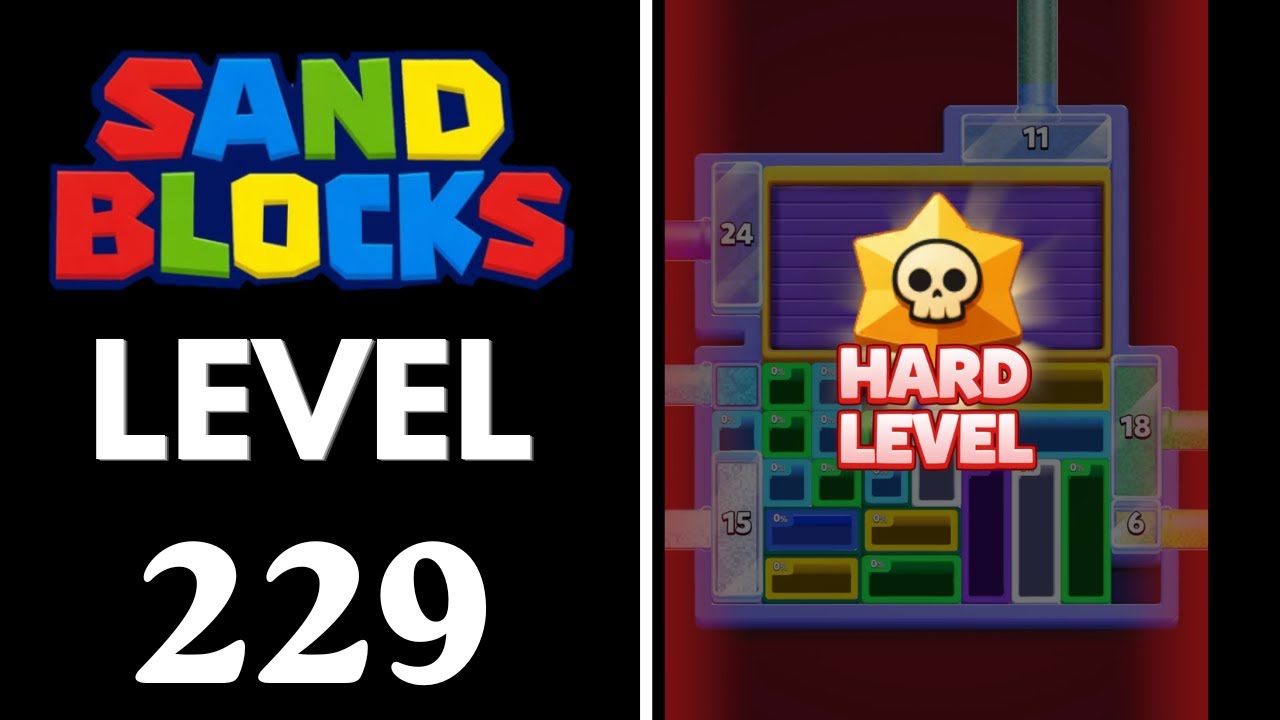
To clear Level 229 in Sand Blocks: Drop Puzzle, you must maintain an even board height and connect continuous, single-color bands from the left wall to the right wall before sand piles cross the upper danger line. Level 229 rotates through four standard colors—red, yellow, green, and blue. Because falling shapes immediately dissolve into loose sand upon impact, uncoordinated drops cause mixed colors to spill across the board and block row completions.
Line Clear Mechanics and Failure Triggers
Unlike grid-locked puzzle games, Sand Blocks: Drop Puzzle uses granular physics. A clear triggers only when a single, unbroken color touches both the left and right borders of the container at the same time.
- Color Contamination: If even a few grains of another color sit inside an otherwise complete horizontal strip, the row will not clear. The blocked strip remains stuck until the contaminating sand above it is cleared.
- The Ceiling Threshold: Allowing sand to settle above the red danger line at the top of the container results in an immediate loss.
- Slope Runoff: Loose sand slides down inclines. Dropping a block directly onto a peaked pile causes grains to roll into neighboring valleys, splitting potential rows.
Early-Game Foundation Strategy
Begin Level 229 by building an even, single-color base across the bottom floor:
- Lay broad shapes flat: Drop horizontal bars or wide blocks along the floor to minimize central peaks.
- Designate discard zones: When you receive a piece that does not match your active bottom layer, steer it completely to the left or right wall. Using the outer edges as temporary zones prevents non-matching colors from spilling into the center floor.
- Bridge low valleys: Fill depressions before starting a new color tier above them. A level foundation ensures subsequent layers drop and settle evenly.
Shape Placement and Orientation
Rotate incoming tetrominoes to match the board's topography and limit loose grain roll.
| Tetromino Shape | Recommended Orientation | Placement Target | Practical Benefit |
|---|---|---|---|
| I-Block (Long Bar) | Horizontal flat | Spanning low ground or wide gaps | Instantly completes or extends a wide single-color band. |
| O-Block (Square) | Standard flat | Tucked against sidewalls | Packs dense volume into corners without intruding on the center. |
| T-Block | Flat edge facing down | Placed over slight valleys | Fills low pockets securely while the top nub settles without rolling. |
| L-Block / J-Block | Long back pressed to wall | Outer container borders | Braces sand against the wall and forces grain roll inward. |
| S-Block / Z-Block | Horizontal stepped | Directly over matching sand mounds | Distributes volume across two steps to prevent steep runoffs. |
Engineering Gravity Cascades
Building clear, horizontal color strata allows you to trigger chain reactions that clear large volumes of sand quickly. When a bottom row clears, all sand suspended directly above it drops instantly.
To set up a cascade, deposit an incoming secondary color evenly across the top of an almost-finished lower band. Once you drop the final piece to dissolve the lower color, the suspended upper layer drops onto the flat surface below. As it impacts the base, the sand flattens horizontally, often bridging the remaining distance between the walls to trigger a second clear automatically.
High-Stack Recovery Tactics
If misdrops push your stack into the upper third of the container, stop planning multi-tier cascades and focus exclusively on emergency space clearing:
- Identify the widest existing band: Look for the color that already spans the largest continuous horizontal width. Rotate and drop matching pieces directly into its remaining gaps to trigger a clear immediately.
- Dump off-colors hard against the edges: Steer unhelpful colors as far to the sidewalls as possible, where stack height is generally lower than in the center.
- Capitalize on vertical drops: A single row clear pulls the surrounding mounds downward, pulling the center peak away from the ceiling threshold and restoring space to rebuild.
Free Sand Blocks: Drop Puzzle Codes
Current active codes and how to redeem them.

Michael Smith
Michael covers live-service games, events, reward systems, and efficient daily routines, turning frequent updates into clear actions for players.
COMMUNITY
Player Comments
145 players commented on this guide.
I tried this today and it worked better than my old setup.
Good guide for Sand Blocks: Drop Puzzle players. The strategy part was useful.
This helped me understand strategy much better.
The explanation is clear, especially for beginners.