
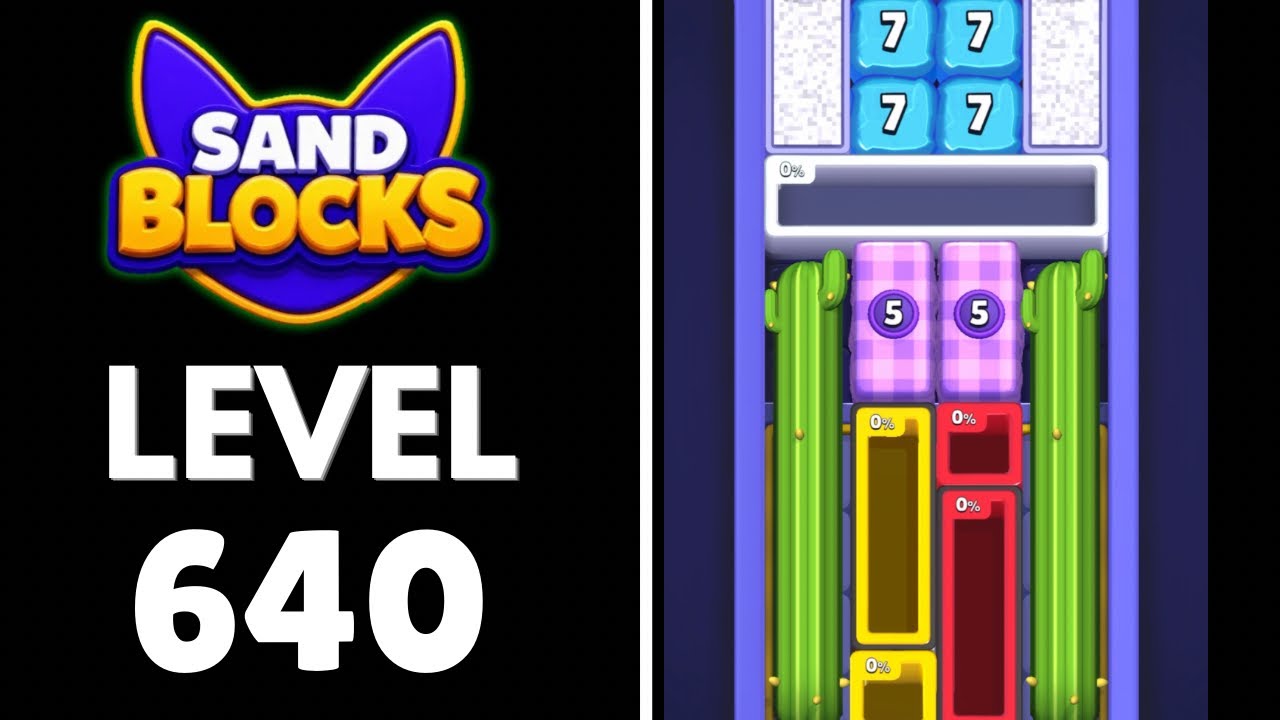
To beat Level 640 in Sand Blocks: Drop Puzzle, keep the board level by directing sand toward the outer walls and completing continuous, single-color horizontal lines from boundary to boundary. Falling blocks disintegrate into loose grains upon contact, meaning drops slide down slopes rather than locking in place. Success requires controlling central mound height and keeping matching colors grouped to trigger clears before sand reaches the top danger line.
Core Mechanics and Win Conditions
A clear triggers only when a single color forms an unbroken horizontal band stretching entirely from the left wall to the right wall. When this connection occurs, the connected mass dissolves, dropping the sand above it and freeing vertical headroom.
Because the incoming piece rotation cycles through different colors, scattering dissimilar blocks across the board traps incomplete layers underneath. Stacking incompatible colors prevents wall contact and rapidly pushes the pile toward the upper boundary.
| Board Element | Mechanical Effect | Player Response |
|---|---|---|
| Sand Dissolution | Rigid polyominoes crumble into sliding grains on impact | Aim into low depressions to fill gaps evenly |
| Wall-to-Wall Clear | Dissolves all connected sand of a single color touching both sides | Focus on completing one color line before switching targets |
| Top Danger Zone | Sand touching the ceiling causes an immediate game over | Flatten high peaks and clear bottom layers to lower the pile |
| Multi-Color Splitting | Alternating colors trap broken patches beneath new sand | Drop off-color shapes into corners away from active lines |
Controlling Shape Orientation and Mound Height
The most common failure point in Level 640 is allowing a pyramid to form in the middle columns. When a central peak grows too steep, incoming sand slides down the flanks uncontrollably, mixing colors and ruining clean horizontal bridges.
Flatten Incoming Shapes
Always rotate blocks so their broadest edge lands flat against the floor or existing mound. Dropping shapes vertically concentrates weight into single columns, forming steep spikes that destabilize later drops. Horizontal placement disperses sand over multiple columns, keeping the top surface predictable.
Anchor the Side Boundaries
Use irregular shapes, such as L-blocks and reverse L-blocks, to reinforce the perimeter. Dropping these shapes flush against the outer boundaries traps sand against the walls, creating stable anchors. Once both walls have established footholds of the same color, bridging the middle gap requires far fewer matching pieces.
Target Depressions
Always guide pieces into the deepest valleys rather than dropping them onto existing mounds. Never drop consecutive blocks into the middle two columns unless doing so completes an active clear. If you receive a piece that cannot contribute to your current color layer, drop it flat into an isolated corner to avoid blocking the main horizontal clearing lane.
Step-by-Step Clear Routine
Maintain a stable board by executing this routine for each falling piece:
- Identify the dominant base color: Check which color already holds the strongest presence connecting either wall toward the center.
- Rotate for maximum width: Turn the incoming block so its flat side faces downward to bridge gaps without adding vertical height.
- Drop into the lowest valley: Release the piece over empty troughs between mounds to maintain an even surface.
- Wait for sand to settle: Allow the loose grains to finish sliding down slopes before lining up your next drop.
- Complete the boundary contact: Fill the final gap between the left and right walls to dissolve the layer, immediately lowering the stack.
Free Sand Blocks: Drop Puzzle Codes
Current active codes and how to redeem them.

Sarah Williams
Sarah specializes in RPG and collection games, explaining team building, character growth, and beginner-friendly ways to avoid expensive early mistakes.
COMMUNITY
Player Comments
29 players commented on this guide.
This guide answered the exact question I had.
The tips are practical and easy to follow.
Nice guide. I am checking the other Sand Blocks: Drop Puzzle articles next.
I wish I had read this before upgrading the wrong thing.