
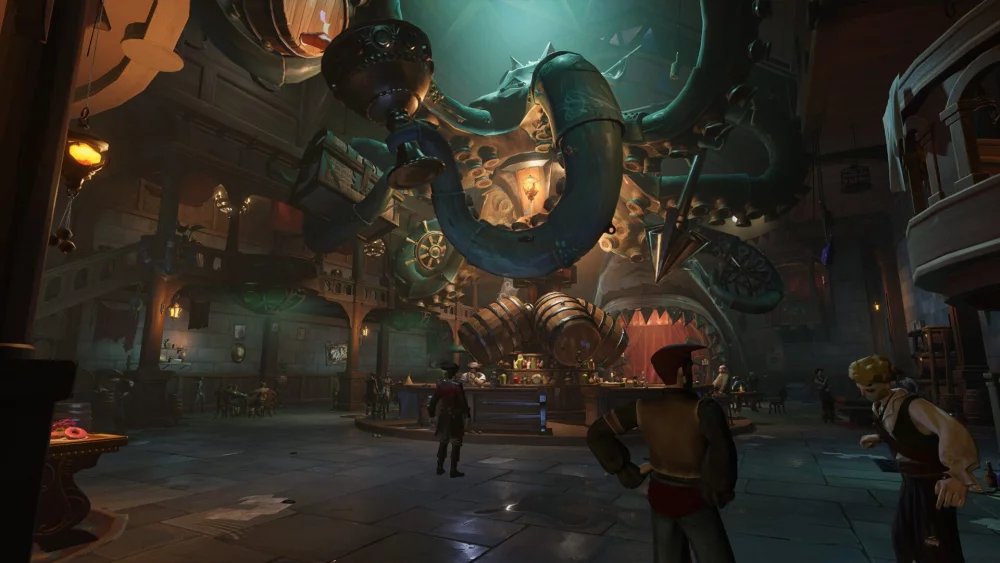
To excel in Sea of Remnants, players must transcend the standard combat loops and master the synergy between team composition, currency management, and environmental awareness. This guide provides the tactical blueprint needed to optimize your resources, build powerful teams, and navigate the game's intricate puppet-punk world with precision.
Strategic Gacha Pulling and Currency Management
In Sea of Remnants, your progress is dictated by your ability to manage limited gacha resources. Frivolous spending is the fastest way to hit a wall in the mid-game.
- Prioritize Banners: Only pull on banners that feature "Core" units—characters who provide team-wide buffs or essential healing. Avoid pulling on debut banners unless you have enough currency to hit the "pity" threshold, as Sea of Remnants rewards long-term planning over impulsive spending.
- The Second Playthrough Reserve: If you are planning a second playthrough or attempting a high-difficulty challenge run, conserve your premium currency. Certain late-game upgrades are locked behind currency-gated vendors that are most efficient to utilize when you have a surplus accumulated from your initial run.
- Resource Allocation: Always prioritize leveling your primary DPS and Support core before investing in secondary units. In Sea of Remnants, a team of three highly invested characters will outperform a team of five mid-tier characters in almost every scenario.
Maximizing Gale: A Support Character Deep Dive
Gale is arguably one of the most versatile support units in the early game of Sea of Remnants. To maximize her combat efficiency, you must understand how her mechanical kit interacts with the game’s turn-based tactical system.
Gale functions best as a "battery" and utility shielder. Her primary skill, Clockwork Aegis, provides damage mitigation that scales based on her defense stat, not her attack. Therefore, when gearing Gale, ignore offensive stats like Critical Hit or Attack Power. Instead, prioritize:
- Defense %: Increases the potency of her shields.
- Speed: Ensures Gale acts before your main DPS, allowing her to buff them before they unleash their ultimate abilities.
- Effect Resistance: Prevents Gale from being crowd-controlled, ensuring your team always has access to their defensive utility.
When playing Gale, hold her ultimate until the enemy initiates a "Telegraphed Attack." These are indicated by a glowing mechanical aura around the boss. Using Gale’s ultimate in response to these cues turns a potential team-wipe into a manageable turn.
Navigating the Puppet-Punk World
The puppet-punk environment of Sea of Remnants is not just aesthetic—it is a map full of tactical information. The game design uses environmental storytelling to hint at incoming dangers.
Reading Environmental Cues
- Mechanical Anomalies: If you spot exposed wiring or leaking oil pipes in a zone, it is a visual indicator of "Construct" type enemies. Adjust your team to include units that deal Piercing or Electrical damage, as these are highly effective against mechanical foes.
- Verticality as Strategy: Many combat maps allow for height-advantage positioning. Use the puppet-punk architecture—climbable pipes, catwalks, and scrap piles—to gain a height bonus. This increases your accuracy and range, making it significantly easier to pick off ranged enemies from safety.
Environmental Stealth
Stealth in Sea of Remnants involves blending into the industrial decay. When navigating areas populated by guard puppets, look for "Static Cover." Standing near junk piles that share the same texture as the local enemy types makes you effectively invisible to basic sensors. Use these spots to bypass patrols entirely, saving your team’s stamina for mandatory boss skirmishes.
Decoding NPC Behavior and Lore
NPCs in Sea of Remnants operate on behavioral loops tied to their internal clockwork. Observing these routines is essential for uncovering hidden quests.
- Ritualistic Patterns: If an NPC is performing a repetitive action (e.g., polishing a specific gear, staring at a wall), watch them for a full cycle. Often, they will reveal a hidden path or drop a key item after a specific number of repetitions.
- Mechanical Jargon: Pay close attention to the terminology NPCs use. If a quest-giver mentions "pressure valves" or "thermal spikes," they are likely providing a hint about the mechanics of an upcoming boss fight in that region. Treating dialogue as a tactical briefing rather than flavor text is what separates veteran players from novices.
Managing Exploration Rhythm
The game uses sensory cues to dictate the intensity of your exploration. When the background mechanical hum deepens or the lighting shifts toward an amber hue, you are entering a "High-Pressure Zone."
- The "Heavy" Atmosphere: When the environment feels oppressive, stop movement. This is a sign that the area contains high-density traps or advanced enemies. Do not sprint here, as the noise generated by your movement can attract mobs.
- The "Clean" Atmosphere: When the environment hums at a higher frequency and the lighting is clear, you are likely in a safe zone or an area rich in scavenging materials. Use these moments to check your inventory, re-equip your units, and prepare for the next encounter.
Expert Strategies for Progression
To maintain a competitive edge throughout the alpha, apply these three core principles:
- Don't Over-Diversify: Focus on building a "Main Four" team. Trying to keep ten characters at the same level will result in a team that is mediocre at everything and master of nothing.
- Check for Weak Points: Every enemy in Sea of Remnants has a structural weak point. In battle, hover over the enemy to see their "Armor Integrity." If the bar is glowing, use an ability that deals "Fracture" damage to expose their core, which will increase all incoming damage to that target by 50%.
- Optimize Stamina: Never waste stamina on low-tier grind nodes. Use the game’s "Auto-Survey" feature to identify which nodes provide the highest amount of crafting materials per stamina point, and focus your daily energy exclusively on those.
By integrating these strategies—from the meticulous management of gacha resources and Gale’s kit to the careful reading of environmental cues—you will find that Sea of Remnants becomes a much more accessible and rewarding experience. Focus on the tactical details, and you will dominate the game’s most difficult encounters.

Free Sea of Remnants Codes
Current active codes and how to redeem them.

James Brown
James focuses on Android gaming on PC, emulator setup, controls, performance tuning, and practical troubleshooting for longer play sessions.
COMMUNITY
Player Comments
43 players commented on this guide.
The explanation is clear, especially for beginners.
The tips are practical and easy to follow.
Can you add more details about strategy in a future update?
I tried this today and it worked better than my old setup.