
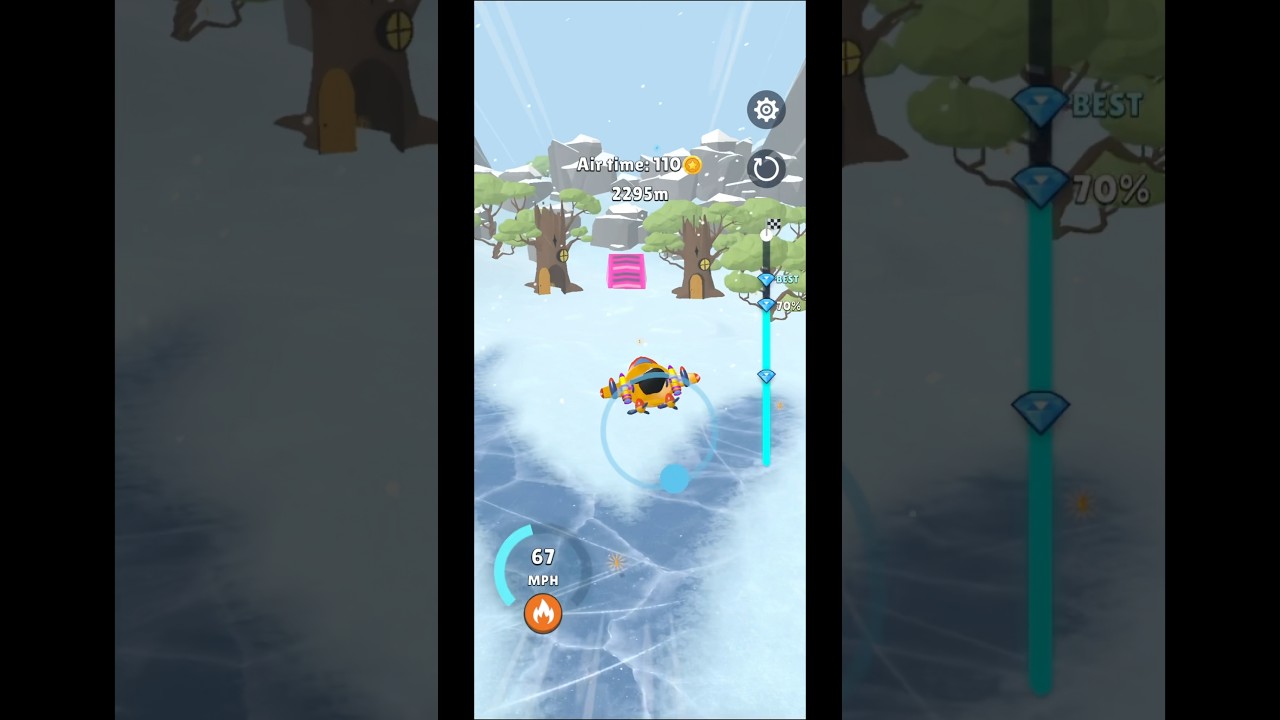
To beat Level 15 in Sled Surfers, replace wide steering swerves with short, rhythmic taps down the center lane and keep your sled runners parallel to the downhill grade before touching down from ramps. Level 15 introduces tightly grouped obstacle corridors, sudden elevation drops, and punishing speed wobbles that will wipe you out if you drift toward the outer snowbanks or over-rotate in mid-air.
Navigating the Dense Tree Corridors
The opening stretch past the starting gate packs pine trees and rocky mounds close together, significantly narrowing the safe path. Attempting wide lateral turns to flank these clusters usually throws your sled into the outer banks or sets you on a collision course with hazards located just beyond the immediate crest.
- Focus two sled lengths ahead: Keep your visual focus ahead of your current position rather than directly in front of your runners so you can identify safe lanes early.
- Aim for midpoint gaps: When two obstacles sit side-by-side, steer directly through the middle space instead of cutting wide around the outer edges.
- Use rhythmic micro-taps: Light directional taps allow you to shift lanes across the snowpack without triggering violent weight transfers.
Stabilizing Ramp Jumps and Landings
Uneven launch ridges and downhill ramps are the primary source of crashes on the middle slopes. Catching air while actively turning twists your sled off-axis, making a crash inevitable upon impact.
Treat mid-slope ramps as balance checkpoints rather than trick opportunities:
- Release steering before the lip: Let go of directional inputs a split second before leaving the snow to launch with a neutral, forward-facing trajectory.
- Align sled pitch with the slope: Match the nose of your sled to the angle of the descending hill rather than letting it sit parallel with the flat horizon.
- Square your runners: Stop all lateral rotation before reaching the ground to ensure the sled runners absorb the impact evenly.
- Hold a neutral line on touchdown: Avoid steering hard during the initial compression second to prevent bouncing erratically into nearby obstacles.
Recovering from Clipping and Speed Wobbles
Brushing against a snowbank or clipping an obstacle hitbox triggers severe steering instability. Trying to force a hard turn while the sled is actively shaking will throw you directly into the nearest tree.
When a clip occurs, immediately release your steering inputs. Allow the sled to coast along its natural fall line for a split second so the runners can regain grip on the snowpack. Once the wobble settles, apply gentle counter-steering to return to the center of the run. Sacrificing a small amount of downhill momentum is necessary to regain full steering control.
Stage Pacing by Course Section
Match your speed to the terrain density to maintain sufficient reaction time throughout the run:
| Course Section | Primary Hazard | Speed Approach | Safe Navigation Priority |
|---|---|---|---|
| Upper Descent | Clustered Pine Trees | Moderate coasting | Micro-tap steering through central gaps |
| Mid-Slope Drop | Hidden Mounds & Sudden Ramps | Neutral glide | Level the sled parallel to the slope grade |
| Choke Point Slalom | Alternating Boulders & Trees | Low to moderate speed | Prioritize center positioning over momentum |
| Final Run-in | Narrow Downhill Corridor | Full acceleration | Hold a straight line directly toward the arch |
Reserve maximum acceleration for the open corridor after clearing the mid-course moguls, where foliage thins out and the track leads straight through the finish line.
Free Sled Surfers Codes
Current active codes and how to redeem them.

Emily Johnson
Emily writes practical mobile strategy guides with a focus on resource planning, base progression, and the early decisions that shape a long-term account.
COMMUNITY
Player Comments
46 players commented on this guide.
Can you add more details about strategy in a future update?
Nice guide. I am checking the other Sled Surfers articles next.
I wish I had read this before upgrading the wrong thing.
This guide answered the exact question I had.