
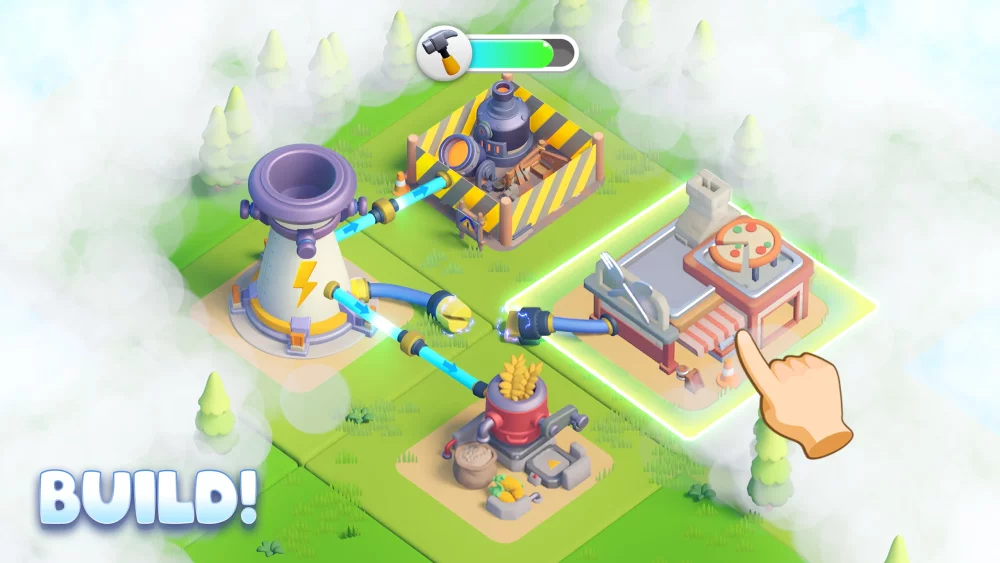
To build a "Mega Base" in Tiles Survive!!, you must stop thinking like a survivor and start thinking like an architect. The transition from early-game survival to late-game dominance hinges on spatial efficiency and infrastructure planning. By organizing your tiles into a logical, high-production layout, you minimize transit time for workers, maximize resource throughput, and create defensive perimeters that can withstand even the most aggressive enemy waves.
The Hub-and-Spoke Efficiency Model
The most common mistake in Tiles Survive!! is sprawling production buildings across the map. This creates massive transit delays for your workers, who spend more time walking between nodes than actually collecting resources.
To solve this, adopt a Hub-and-Spoke model:
- Central Warehouse: Place your primary storage facility at the dead center of your base.
- Production Rings: Arrange your resource producers (wood cutters, stone extractors, food generators) in concentric circles immediately surrounding the warehouse.
- Service Lanes: Ensure there are clear, unobstructed paths between each production unit and the central hub. Avoid placing decorative items or non-essential obstacles in these lanes.
This layout ensures that the "travel time" for your workers is kept to the absolute minimum, effectively increasing your total hourly yield without the need for additional labor units.
Tactical Defensive Perimeter Design
In Tiles Survive!!, your defense is only as good as your geometry. Building a flat line of walls is a recipe for disaster; enemies will simply swarm the weakest point. Instead, you must manipulate enemy pathing through "choke points."
Constructing Effective Choke Points
- Zigzag Walls: Avoid straight segments. Use a "stair-step" or zigzag pattern to break up the enemy line of sight and movement.
- Focus Fire Zones: Design your wall layouts so that enemies are forced to enter through a single, narrow opening. Place your high-damage defensive turrets directly facing these entries.
- Corner Hardening: If resources are tight, prioritize upgrading the "corner" tiles of your perimeter first. These are the tiles most frequently targeted by waves and are the most susceptible to structural collapse during intense combat.
By forcing enemies to funnel into a single tile, you concentrate your defensive output, making your base feel significantly stronger than the sum of its parts.
Tiered Progression and Verticality
As your base footprint grows, you will eventually run out of ground space. Tiles Survive!! rewards players who transition from a flat, sprawling layout to a tiered, vertical system.
- Foundation First: Always build your most critical, high-output machinery on the ground floor, reinforced with the strongest tiles available.
- Secondary Facility Relocation: As you expand, move non-essential structures (like basic storage or decorative buildings) to the outer perimeter or onto elevated platforms.
- Structural Integrity: Remember that verticality increases the risk of "domino failure." If a support beam is destroyed, every building attached to it may experience a massive penalty to production or total failure. Always keep a surplus of building materials in your inventory for instant, mid-wave repairs.
Master the Iterative Expansion Strategy
Never attempt to reorganize your entire Mega Base in one go. Doing so disrupts production cycles and leaves you vulnerable to incoming waves. Instead, use an iterative, four-phase expansion strategy:
| Phase | Focus | Objective |
|---|---|---|
| Phase 1 | Central Hub | Solidify storage and primary resource pathways. |
| Phase 2 | Defense | Upgrade perimeter chokepoints with high-tier materials. |
| Phase 3 | Secondary Shift | Move non-essential buildings to the base perimeter. |
| Phase 4 | Optimization | Implement vertical storage and high-tier machinery upgrades. |
By moving one sector at a time, you ensure that even while your base is under construction, it remains functional. Always monitor your total energy output during these shifts; if your power grid fails because you moved a generator too far from a consumer, your entire production line can grind to a halt.
Pro-Tips for Mobile Precision
Because Tiles Survive!! is often played on mobile, precision is key.
- Use the Grid-Snap: Always enable the grid-snap feature when laying out your Mega Base. Minor alignment errors can cause pathing bugs where workers become "stuck" behind invisible collision boxes, severely hampering your efficiency.
- Proactive Maintenance: If a tile changes color or visual texture, it is signaling wear and tear. Do not wait for a collapse. Replacing a damaged tile proactively costs significantly less than rebuilding the entire structure and its contents after an enemy breach.
Expert Insight: Why Logic Beats Raw Power
The biggest secret to high-tempo survival in Tiles Survive!! is not having the most units, but having the most consistent ones. A base with 20% fewer workers but 50% higher efficiency due to a condensed Hub-and-Spoke layout will always outperform a disorganized base with more workers.
Focus your decision-making on "Time-to-Task." Every time you place a new building, ask yourself: How long does it take my worker to get from this building to the warehouse? If the answer is more than two seconds, reconsider your placement. By strictly enforcing this rule, you will naturally develop a Mega Base that is inherently optimized for the end-game's high-pressure demands.

Free Tiles Survive! Codes
Current active codes and how to redeem them.

Michael Smith
Michael covers live-service games, events, reward systems, and efficient daily routines, turning frequent updates into clear actions for players.
COMMUNITY
Player Comments
97 players commented on this guide.
I wish I had read this before upgrading the wrong thing.
Can you add more details about resources in a future update?
This helped me understand resources much better.
Nice guide. I am checking the other Tiles Survive! articles next.