
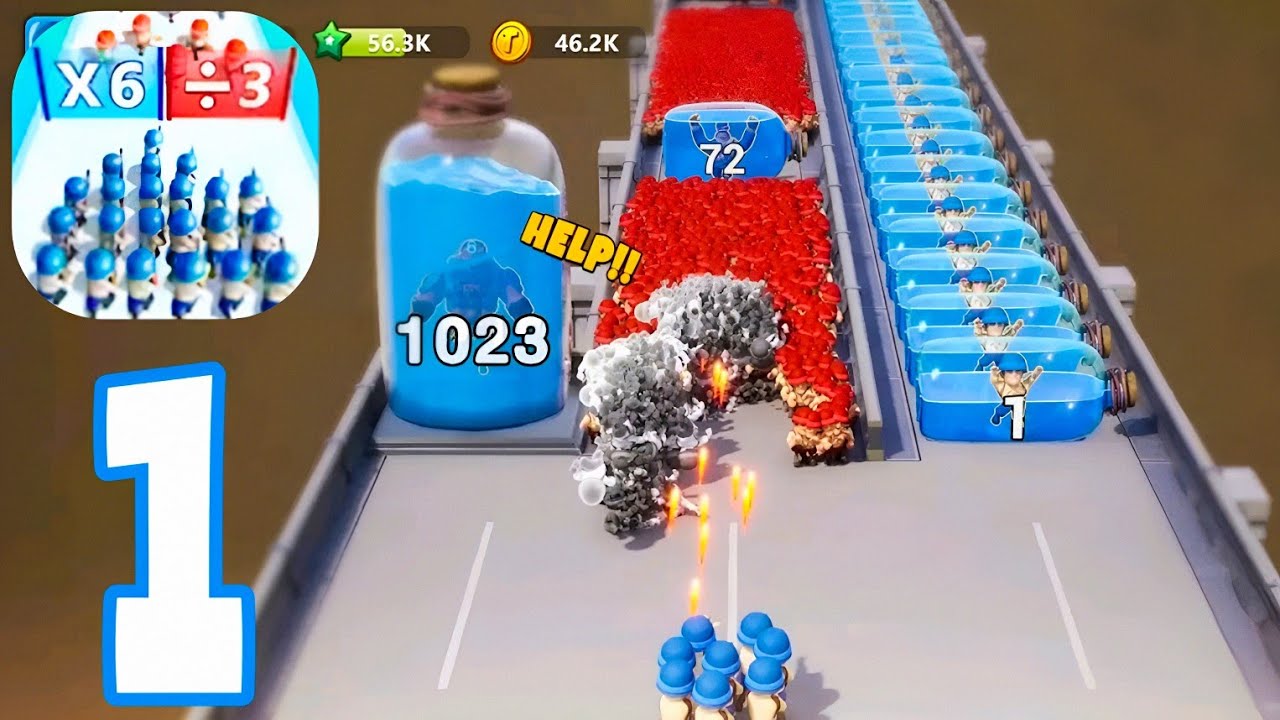
In Top War: Battle Game, your ability to conquer islands and defend your territory hinges entirely on one core mechanic: merging. While the game provides an endless stream of low-level troops, the difference between a struggling commander and a dominant force lies in how efficiently you evolve those troops into high-tier combat assets. This guide breaks down exactly how to manage your deployment field, optimize your merge chains, and maximize your combat power to progress through the most challenging island campaigns.
The Core Mechanics of Unit Evolution
At its simplest level, Top War: Battle Game follows a linear progression: two units of the same level and type can be dragged onto each other to create a single unit one level higher. However, understanding why this matters is the key to success.
A single level-10 unit is not just "equal" to two level-9 units; it is exponentially more powerful. Higher-level units boast improved statistics for both health and damage, meaning they survive longer on the battlefield and contribute more to the "Power" metric used to calculate combat outcomes.
Why Merging is Non-Negotiable:
- Efficiency per Tile: Your deployment field is a finite grid. Keeping a field full of level-1 units clogs your ability to produce more. Merging is the only way to clear "dead space" while increasing your army's raw output.
- Survivability: Lower-level units are easily wiped out by enemy structures. By consolidating your forces, you ensure that your army is comprised of units capable of weathering incoming fire.
- The "Power" Threshold: Most missions and base-clearing objectives have a recommended power level. If your power is lower than the requirement, you will suffer heavy attrition, losing your basic units and stalling your resource generation.
Optimizing Your Deployment Field
The deployment field is your most important workspace. Many novice players make the mistake of filling every available tile with the lowest-level units possible. This creates a bottleneck where you cannot produce new units because there is no room to merge.
To manage your field like an expert:
- Prioritize the Grid: Keep your highest-level units in the center or front-line positions.
- Constant Consolidation: If you have two units of the same level, merge them immediately. Do not hoard basic units unless you are waiting for a specific production boost or event.
- Strategic Clearing: As you clear sections of your island, you will unlock more tiles. Use this extra space to set up "production lines" where you merge units in a specific corner of the map before moving them to the front lines.
Executing Perfect Island Raids
Combat in Top War: Battle Game is not just about having the biggest army; it is about having the most efficient one. Before you commit to an attack on a new sector of your island, follow these steps:
- Check the Power Gauge: Always look at the enemy's defensive strength versus your own. If your power is within 5-10% of the enemy, you need to merge more units before engaging.
- Observe Unit Types: Remember the triangle of combat: Land, Navy, and Airforce. If the enemy has a strong defensive fortification, ensure you are using the correct unit type to counter them.
- Don't Rush the Boss: When attacking an island boss, the damage output of a few high-level units is almost always superior to a swarm of low-level units. A high-level unit can survive the initial volley of fire, allowing it to sustain damage over time.
Advanced Strategies: Production vs. Merging
The most common mistake in Top War: Battle Game is depleting your resources on low-level units that you don't have the space to merge. To maintain a steady upward curve of power, you must balance your economic output with your military growth.
The "Wait and Merge" Philosophy
If your field is full and you only have one or two units of a certain level, resist the urge to deploy them into a losing battle. Instead, wait for your base production to generate the missing pieces for your next merge. It is better to have ten level-15 units than fifty level-5 units. The fifty units will be destroyed in seconds, while the ten level-15 units can often clear entire defensive encampments on their own.
Managing Decorations and Base Layout
While decorations might seem like a distraction, they are vital for organizing your base. Use them to create distinct zones: one for production, one for staging/merging, and one for your main combat force. By keeping your "merge zone" clean, you reduce the time it takes to scan for pairs, allowing you to react faster during time-sensitive events.
Common Mistakes to Avoid
- Over-deploying: Do not put units on the field that you cannot immediately merge or use. This wastes space that could be used for higher-tier production.
- Ignoring Hero Synergies: While this guide focuses on merging, remember that your Heroes provide massive buffs to specific unit types. Always pair your strongest units with the Heroes that provide bonuses to their specific branch (Land, Air, or Navy).
- Forgetting to Expand: Always prioritize clearing tiles on your island. The more tiles you have, the more "workspace" you have to perform complex merge chains, which leads to higher-level units much faster.
Conclusion: The Path to Power
Success in Top War: Battle Game is a marathon, not a sprint. By focusing on merging as your primary method of progression rather than just "buying more troops," you will naturally find yourself with a significantly higher combat power than other players at your level. Always prioritize tier density, keep your deployment field organized, and never engage in combat until your merge-path is exhausted. With these habits, you will turn your island from a small outpost into a formidable military powerhouse.
Free Top War: Battle Game Codes
Current active codes and how to redeem them.

Emily Johnson
Emily writes practical mobile strategy guides with a focus on resource planning, base progression, and the early decisions that shape a long-term account.
COMMUNITY
Player Comments
34 players commented on this guide.
This helped me understand base building much better.
This saved me time in the early game.
The tips are practical and easy to follow.
Good guide for Top War: Battle Game players. The base building part was useful.