
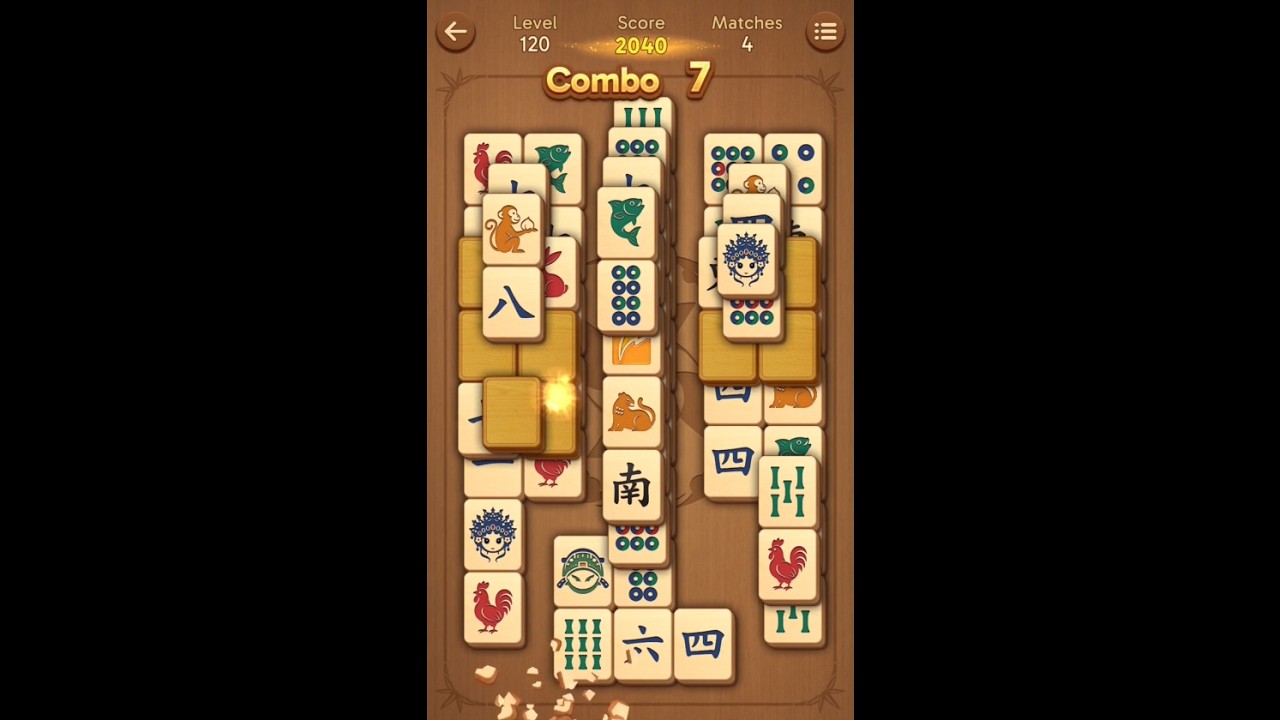
To clear Levels 111 through 120 in Vita Mahjong without hitting deadlocks, dismantle tall, multi-layered central formations before taking easy perimeter matches. The layouts in this stage range feature overlapping rows and dense vertical stacks that hide critical matching pieces underneath. Preserving open border tiles while breaking down core stacks ensures you reveal blocked pieces without running out of playable moves.
Dismantling Central Stacks and Balancing Wings
Tall central columns hide unknown tiles that determine whether future matches will be possible. Grabbing exterior pairs too early often discards the only available match for a tile buried several layers deep.
When evaluating the board, apply these priorities:
- Target the highest elevation first: Focus matches on tiles that sit on multi-tier central columns to expose the hidden faces beneath them and free adjacent pieces.
- Pair center tiles with outer tiles: If an available match uses one piece from a high central column and one piece from an outer wing, take it immediately to reduce depth while keeping board flexibility.
- Balance symmetrical sides: If identical tiles appear on both the left and right wings, avoid pairing them directly together. Instead, check if either twin can pair with a central piece. If you must clear wing tiles, alternate evenly between sides rather than clearing one side completely.
| Layout Feature | Recommended Action | Common Mistake |
|---|---|---|
| Tall Center Columns | Clear upper layers step-by-step | Stripping perimeter tiles while stacks remain untouched |
| Identical Twin Tiles | Pair one twin with a center tile | Matching two outer twin tiles together immediately |
| Symmetrical Wings | Clear evenly across both flanks | Emptying one flank entirely, stranding the other |
| Honor Tiles | Clear them as soon as they unlock lower layers | Holding honor pairs without gaining board visibility |
Tracking Tile Counts to Avoid Deadlocks
Standard suits (Dots, Bamboo, and Characters) contain four copies of each tile, forming two matching pairs. Stalemates in levels 111–120 commonly occur when the final two copies of a tile end up blocking each other in the same column or corridor.
- Scan visible duplicates: When two copies of a tile are open, check if a third copy is visible on the board.
- Locate the fourth copy: If the third copy is pinned, inspect where the fourth copy might be resting. If taking the current pair leaves a pinned copy with no accessible partner, pause and prioritize clearing the obstruction above that third or fourth tile first.
- Clear Honor tiles promptly: Winds (East, South, West, North) and Dragons (Red, Green, White) do not have sequential numerical relationships. Treat them purely as structural blockers, pairing them off whenever they uncover underlying pieces.
Clearing Overlapping Corridors and Holding Reserves
Horizontal rows in these levels frequently overlap by half a tile width, pinning single tiles beneath two adjacent ones.
- Work toward the widest opening: In interlocking horizontal chains, clear from the end that unlocks the most tiles. If clearing from the right reveals two accessible pieces while clearing from the left only reveals one, route matches through the right.
- Keep isolated edge tiles in reserve: Tiles sitting alone on outer borders that do not cover other pieces or pin central stacks should be left on the board. As the board thins to its final tiles, these untouched perimeter pieces serve as essential escape options to pair with newly uncovered core tiles.

Free Vita Mahjong Codes
Current active codes and how to redeem them.

Michael Smith
Michael covers live-service games, events, reward systems, and efficient daily routines, turning frequent updates into clear actions for players.
COMMUNITY
Player Comments
65 players commented on this guide.
I tried this today and it worked better than my old setup.
The explanation is clear, especially for beginners.
This saved me time in the early game.
This helped me understand strategy much better.