
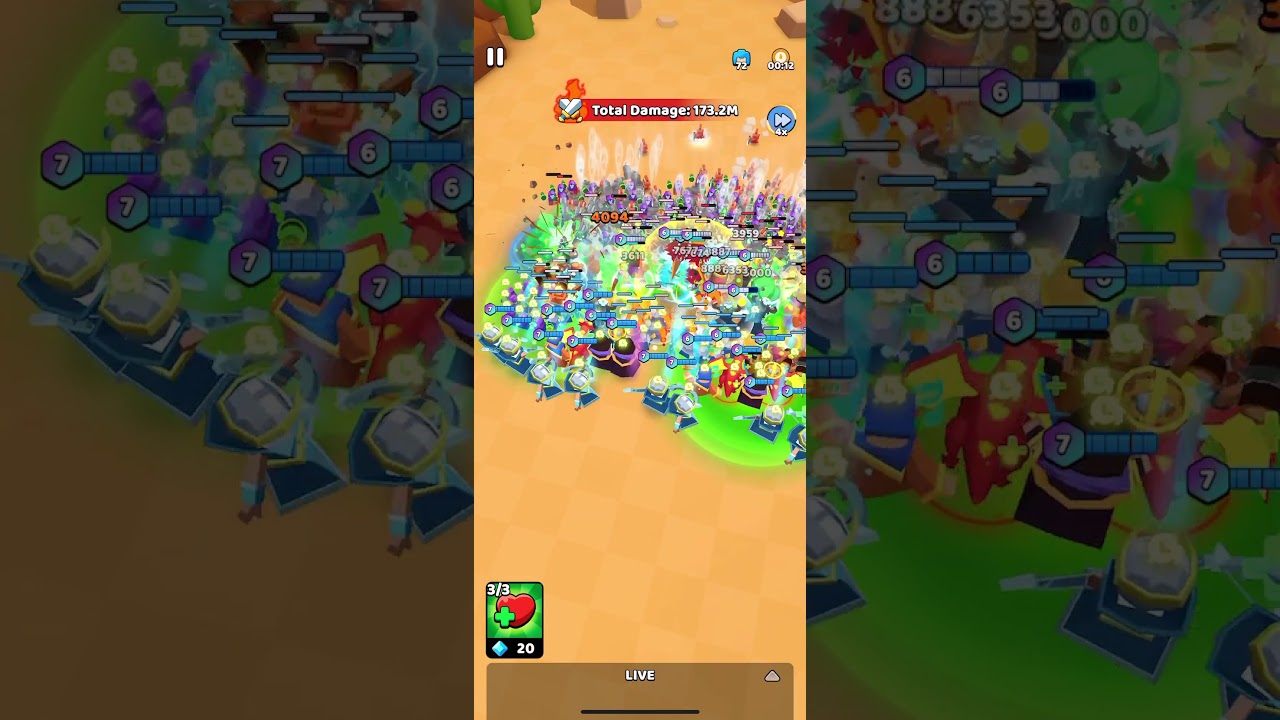
To maximize your score in the Infinite War mode of War Inc: Rising, fill every board slot with low-tier units before merging, anchor the track's entry choke point with crowd control, and invest in class mana upgrades once individual summon costs exceed upgrade prices.
Board Saturation and Merging Timeline
Early survival depends on total attack volume rather than a few high-tier units. Merging two Tier-1 units into a single Tier-2 unit reduces your total attack frequency and target acquisition. Two separate ranged units hit multiple incoming targets and trigger more attacks, preventing early swarms from leaking past your defenses.
Keep your board fully saturated and follow this progression across wave brackets:
| Wave Phase | Board Focus | Merge Action |
|---|---|---|
| Waves 1–15 | Fill every open grid tile with active units | Merge only duplicate utility units or when board space is completely locked |
| Waves 16–35 | Level troop class mana via the upgrade bar | Consolidate duplicate damage dealers into Tier-3 and Tier-4 units |
| Waves 36+ | Maximize damage carry star tiers | Roll for high-tier crowd control anchors and single-target boss burst |
Only merge units when the board is completely full and you need space for new summons, or when you are consolidating duplicate carries to unlock higher-tier passives.
Choke Point Control and Carry Placement
Enemy movement speed scales alongside health as waves advance. Pure damage output will fail if fast enemies pass through your firing lines before taking full damage.
- Anchor the spawn entry: Place slowing or freezing units directly at the track's initial entry curve. Slowing enemies early groups them tightly together, allowing area-of-effect (AoE) attackers to strike the maximum number of targets per hit.
- Avoid backline control clusters: If control units sit near the exit, high-speed mini-bosses will bypass your burst damage before crowd control triggers. Keep at least two dedicated control units along the early path.
- Place primary carries centrally: High-damage carries must occupy central grid tiles with lines of sight across multiple lane segments. Central placement allows carries to fire at approaching enemies and hit them again as they loop around.
- Reserve borders for utility: Place aura generators, passive buffers, and single-target debuffers along the outer perimeter where attack uptime matters less.
Balancing Summons Against Class Mana Upgrades
Every summon increases the silver or mana cost of subsequent summons. Continuing to summon on a full board gives diminishing returns compared to class-wide stat upgrades.
- Check summon cost against upgrade cost: Compare your current summon price to the cost of leveling a class on the bottom upgrade bar.
- Evaluate unit concentration: If you have three or more units belonging to your primary damage class and the summon cost exceeds the class upgrade cost, purchase the class mana upgrade immediately.
- Targeted summons: Save high-cost summons for times when you need to replace merged slots or fish for a missing crowd control unit.
Managing Late-Wave Bosses
Boss health pools increase dramatically past wave 40. Wide AoE damage handles swarms but will stall against fortified boss health bars without concentrated single-target fire.
Do not panic-merge your defensive line when a boss spawns. Merging multiple units into a single high-tier attacker weakens your total board coverage and usually causes an immediate loss on the subsequent swarm wave. Instead, hold your defensive layout, let your entry choke point slow the boss within your central kill zone, and spend spare mana to finalize the class upgrade level for your primary damage carries. Maintain a mix of wide-clearing AoE and dedicated single-target damage through the end of the run.

Free War Inc: Rising Codes
Current active codes and how to redeem them.

Emily Johnson
Emily writes practical mobile strategy guides with a focus on resource planning, base progression, and the early decisions that shape a long-term account.
COMMUNITY
Player Comments
127 players commented on this guide.
Can you add more details about strategy in a future update?
The tips are practical and easy to follow.
The explanation is clear, especially for beginners.
I wish I had read this before upgrading the wrong thing.