
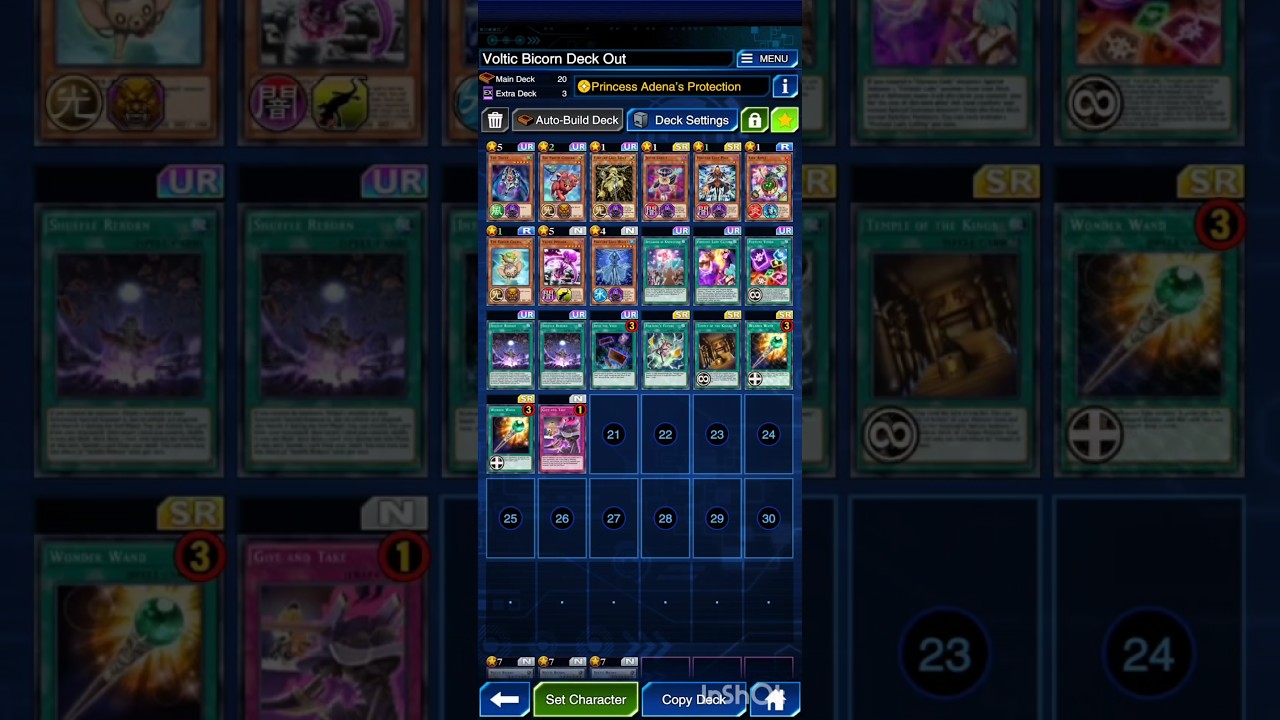
To win by deck-out in Yu-Gi-Oh! Duel Links, survive the opponent's early offensive turns with defensive backrow while actively depleting their Main Deck until they cannot draw during their Draw Phase. Under Speed Duel rules, an inability to draw results in an immediate loss. Because competitive players routinely run 20-card decks and aggressively search for combo pieces, you only need to remove a small number of cards to secure victory without reducing their Life Points to zero.
How Speed Duel Format Rules Enable Deck-Out Wins
In Yu-Gi-Oh! Duel Links, Speed Duel rules enforce a Main Deck size of 20 to 30 cards. Competitive players overwhelmingly run exactly 20 cards to maximize opening consistency.
This compact deck size leaves opponents vulnerable to mill strategies:
- Starting Deck Size: Opening hands take four cards, immediately reducing the deck to 16 cards before the match starts.
- Going-Second Draw: A player going second draws on Turn 2, reducing their deck to 15 cards.
- Combo Searching: Standard opening combos utilize skills, search spells, and monster effects to summon from the Extra Deck, frequently pulling four to eight cards from the Main Deck across Turns 1 and 2.
After completing their initial setup, an aggressive opponent often has fewer than ten cards remaining. Resolving two or three mill triggers while negating incoming attacks depletes the rest of their deck.
Core Mill Engines and Recursion Cards
A deck-out strategy relies on monsters that trigger deck depletion upon leaving the field, being destroyed, or flipping face-up. Pairing these cards with revival traps repeats their effects across multiple turns.
| Card Name | Card Type | Trigger Condition | Tactical Function |
|---|---|---|---|
| Warm Worm | Effect Monster | Destroyed by battle or card effect | Sends the top 3 cards of the opponent's deck to the Graveyard |
| Ghostrick Skeleton | Effect Monster | Flipped face-up | Banishes cards face-down from the opponent's deck equal to your face-up Ghostricks |
| Hiro's Shadow Scout | Flip Monster | Flipped face-up | Forces the opponent to draw 3 cards and discards any drawn spells to the Graveyard |
| Powerful Rebirth | Continuous Trap | Trap activation | Special Summons a Level 4 or lower monster from your Graveyard with +1 Level |
Warm Worm acts as the standard engine piece. When destroyed by battle or an opponent's removal effect, it mills three cards. Activating Powerful Rebirth or Regretful Rebirth returns Warm Worm to the field to trigger another three-card mill upon its next destruction.
If you face decks that activate effects from the Graveyard, Ghostrick Skeleton serves as a safer alternative. Banishing cards face-down permanently removes them from play, preventing opponents from triggering Graveyard recursion.
Defensive Backrow and Hand Traps
You must survive multiple battle phases while your mill engine works. Combine damage-negating hand traps with board disruption that halts attacks without replenishing the opponent's Main Deck.
- Sphere Kuriboh: Discard from your hand when an opponent's monster declares an attack to shift that monster into defense position. This stops lethal damage even if the opponent destroys your backrow cards with Mystical Space Typhoon or Cosmic Cyclone.
- Kiteroid: Discard from your hand to reduce damage from a direct attack to zero, then banish it from the Graveyard to negate a second direct attack later in the duel.
- Floodgate Trap Hole: Activate when the opponent summons a monster to flip it into face-down defense position permanently. This clogs one of their three monster zones and prevents Extra Deck summons.
- Drowning Mirror Force: Activate when an opponent declares a direct attack to shuffle all their attack-position monsters into the deck. While shuffling Main Deck monsters back extends the duel, Extra Deck monsters return directly to the Extra Deck instead of the Main Deck, removing offensive threats safely.
Step-by-Step Match Execution
- Turns 1 and 2 (Stabilize the Board): Set one mill monster, such as Warm Worm, and set two defensive traps. Do not rush your activations. Let the opponent execute their standard search lines, as every card they pull from their own deck accelerates your win condition for free.
- Turns 3 and 4 (Trigger Mill Loops): Check the duel log to monitor the opponent's remaining card count. When their Main Deck drops to six or fewer cards, activate revival traps to recycle Warm Worm or flip Hiro's Shadow Scout. Force the opponent to attack into your defensive backrow to trigger destruction effects during their Battle Phase.
- Turn 5 and Beyond (Confirm Draw-Phase Lock): Once the opponent's Main Deck reaches zero cards, end your turn without attacking into potential defensive cards. When the opponent enters their Draw Phase and cannot draw, the game automatically awards you the victory.
Matchup Weaknesses and Adjustments
Deck-out strategies face specific risks against certain deck types:
- Graveyard-Reliant Decks: Archetypes such as Phantom Knights, Orcust, or Blue-Eyes benefit when cards are sent to the Graveyard. Milling their starters directly accelerates their plays. Against these matchups, rely on Ghostrick Skeleton's face-down banish or tech in D.D. Crow to banish key combo targets from their Graveyard.
- 30-Card Decks: Opponents playing 30-card builds have an extra ten-card buffer. This forces you to survive several additional turns. In these matchups, do not waste defensive hand traps on non-lethal hits; save your negations exclusively for lethal pushes and loop your revival traps as efficiently as possible.

Free Yu-Gi-Oh! Duel Links Codes
Current active codes and how to redeem them.

Michael Smith
Michael covers live-service games, events, reward systems, and efficient daily routines, turning frequent updates into clear actions for players.
COMMUNITY
Player Comments
95 players commented on this guide.
This guide answered the exact question I had.
This saved me time in the early game.
Good guide for Yu-Gi-Oh! Duel Links players. The strategy part was useful.
Can you add more details about strategy in a future update?