
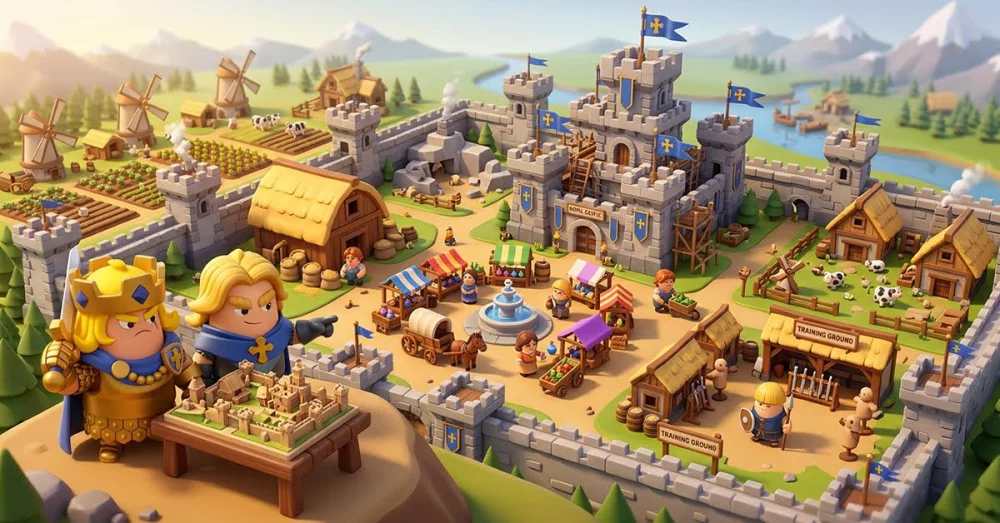
To survive and thrive in Zomline Survival, players must master the delicate balance between aggressive resource acquisition and efficient infrastructure development. Unlike traditional tower defense games, Zomline Survival demands a 4X-style approach where your base is a living, breathing economy that must support both your population and your defensive frontlines. This guide provides the expert framework needed to optimize your settlement’s growth, prevent resource bottlenecks, and ensure your survival against increasingly difficult waves.
The Core Economy: Prioritizing Resource Gathering Efficiency
In the early game of Zomline Survival, your primary directive is to establish a self-sustaining loop. Success is not found in clearing the entire map immediately, but in "precision harvesting."
Every piece of debris or resource node on the map represents a finite opportunity. Your initial hours should focus on clearing just enough space to house your core production buildings.
- The Bottleneck Rule: Always identify your most depleted resource. If you are low on wood, your labor force should be strictly dedicated to wood-harvesting nodes.
- Storage Management: A common mistake is harvesting beyond your storage capacity. Before initiating a massive gathering spree, ensure your storage facilities are upgraded to accommodate the surplus. If you hit your cap, your survivors essentially "waste" labor time by working on nodes that yield no net gain.
- Node Proximity: Prioritize harvesting nodes closest to your base. Not only does this reduce travel time for your survivors—increasing your resources-per-minute—but it also clears space for defensive wall placement, which is vital for later stages.
Scaling Your Settlement Infrastructure
Your base development should follow a "Production-First" philosophy. In Zomline Survival, infrastructure serves one of two purposes: resource generation or survivor utility.
When deciding which building to upgrade, use the Utility Hierarchy:
- Primary Resource Generators: These are your lifeline. Always prioritize upgrading these over residential buildings. If you cannot feed your population, you cannot grow your population.
- Storage Facilities: Only upgrade these when you are consistently hitting your current capacity.
- Defensive Structures: Upgrade these only when your current perimeter is secure or when you are preparing to expand your borders.
- Residential Buildings: Expand these only when you have a surplus of food and resources to support the incoming influx of survivors.
By following this order, you ensure that your economic output always scales ahead of your population demand. An overpopulated base with insufficient production will collapse under the weight of its own consumption.
Optimizing Survivor Labor and Task Allocation
Your survivors are your most valuable currency. Managing them effectively requires moving away from a "set it and forget it" mentality. In Zomline Survival, you must actively rotate labor based on the immediate threats and needs of the colony.
Pro-Tip for Labor Allocation:
- The "Construction Sprint": When you initiate a major building upgrade, manually move your most efficient survivors to the construction site. This significantly reduces completion time. Once the building is finished, immediately reassign them to production lines.
- Idle Management: Periodically scan your base for idle icons. An idle survivor is a wasted resource. If you have no immediate construction, they should be assigned to the most critical resource node, even if it’s just to pad your stockpiles.
- The Reserve Strategy: Always keep at least 10–15% of your population unassigned to specific production roles. This "floating" labor force is essential for emergency repairs after zombie raids or for rapidly clearing new expansion zones.
Balancing Expansion and Defensive Readiness
Expanding your territory is the most dangerous phase of gameplay in Zomline Survival. Every new zone you claim increases the surface area you must defend.
The Expansion Checklist: Before you push into new territory, ask yourself three questions:
- Do I have the materials for a full wall perimeter? Never clear an area unless you can immediately fortify it. A partially walled base is an invitation for a disaster.
- Are my current resources stable? If your food or electricity (if applicable) is fluctuating, do not expand. Stability must be achieved at your current size before you scale up.
- Is my military force positioned? Ensure your defensive towers or hero units are already positioned near the new border before the debris is cleared.
Remember, a compact, heavily fortified base is infinitely more sustainable than a massive, sprawling settlement that is constantly under siege.
Strategic Timing for Building Upgrades
Construction is a massive sink for both time and resources. To stay ahead of the difficulty curve, you must avoid the "simultaneous upgrade trap."
If you trigger three different building upgrades at once, you will find yourself in a resource deficit, unable to repair walls or feed your people if a raid occurs. Instead, utilize Staggered Construction:
- Primary/Secondary Priority: Always have one high-utility upgrade (like a Food Plant) running, and keep your other labor units focused on active gathering.
- Emergency Buffer: Maintain a "Safety Stockpile." Never spend your last 200 units of a resource on an upgrade. Keep that reserve for emergency repairs or rapid-response unit training.
Common Mistakes to Avoid
Even experienced players often fall into these traps:
- Ignoring Hero Specialization: Your heroes are not just combat units; they often have passive buffs to resource collection or construction speeds. Ensure your heroes are stationed in districts where their specific skills are active.
- Over-Expansion: Clearing the whole map too early makes it impossible to defend. Only clear what you can effectively patrol.
- Neglecting Repairs: After a wave, your first priority is not upgrading—it is repairing. A weakened wall section is a permanent vulnerability that zombies will exploit in the next wave.
Conclusion: Achieving Long-Term Sustainability
Success in Zomline Survival is defined by your ability to plan three steps ahead. By prioritizing your production economy, managing your labor force with tactical rotations, and expanding your territory only when your defensive infrastructure is ready, you create a settlement that can withstand the harshest zombie incursions. Use the strategies outlined above to turn your struggling base into a thriving, self-sufficient fortress. Keep an eye on your resource flow, stay disciplined with your expansion, and always keep a reserve of labor and materials ready for the unexpected.

Free Zomline Survival Codes
Current active codes and how to redeem them.

James Brown
James focuses on Android gaming on PC, emulator setup, controls, performance tuning, and practical troubleshooting for longer play sessions.
COMMUNITY
Player Comments
114 players commented on this guide.
I wish I had read this before upgrading the wrong thing.
Can you add more details about early game in a future update?
Nice guide. I am checking the other Zomline Survival articles next.
This helped me understand early game much better.