
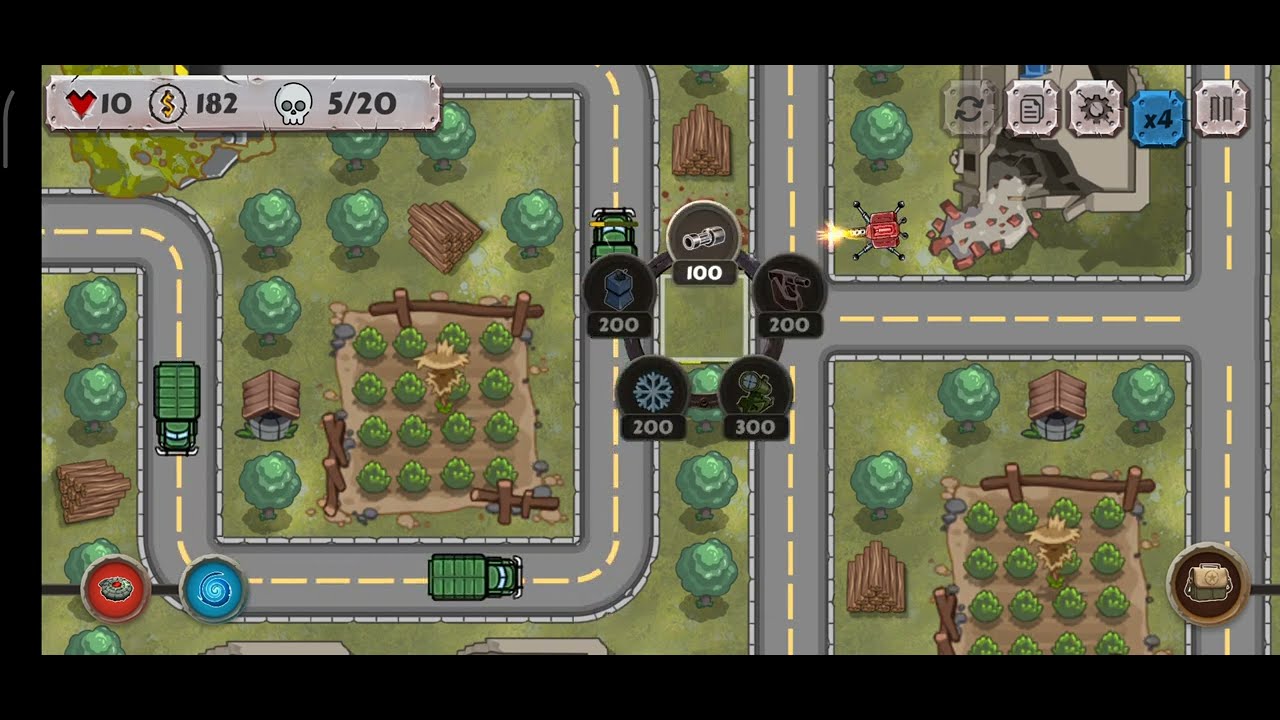
To beat Season 2 Level 12 in Battle Strategy: Tower Defense, concentrate your defense at the central intersection where the two enemy lanes merge rather than splitting resources across both spawn points. Establish early machine gun coverage to eliminate fast infantry, transition to heavy artillery before armored units arrive on wave four, and save commander strikes for clustered vehicle pushes.
Core Tower Setup and Placement
Level 12 splits incoming forces across two separate paths that meet before reaching your base. Building independent defenses at each spawn point drains your funds and leaves you with weak emplacements. Instead, anchor your primary damage dealers along the shared convergence corridor to cover both lanes with the same investment.
| Tower Type | Placement | Tactical Role | Upgrade Priority |
|---|---|---|---|
| Machine Gun Turret | Lane entry corners | Strips infantry shields and kills scouts | Early (Level 1–2) |
| Slow / Cryo Emplacement | Choke point entrance | Clusters vehicles for area splash damage | Single-tier support |
| Heavy Cannon / Artillery | Central intersection | Deals heavy splash damage to armored hulls | Mid-to-late (Level 3+) |
| Rocket Battery | Rear interior tiles | Delivers long-range bursts to heavy armor | Late game |
Place a slow emplacement at the entrance of the central kill zone so enemy vehicles bunch together. Position at least two machine gun turrets adjacent to the slow field to quickly eliminate light escort units. This ensures your heavier cannons do not waste slow, high-damage shells on low-threat targets.
Wave-by-Wave Progression
Surviving Level 12 depends on pacing your upgrades rather than filling every empty tile with base-level towers.
Waves 1–3: Early Perimeter
- Place two machine gun turrets directly at the lane merger during wave one.
- Spend the bounty from initial infantry kills to upgrade one machine gun to level 2 immediately instead of purchasing a third turret. A level 2 turret has sufficient fire rate and penetration to handle waves two and three without leaking units.
- Save all remaining gold from these early waves to prepare for heavier armor.
Waves 4–5: Armored Incursion
- Light vehicles arrive on wave four. Deploy a heavy cannon directly behind your front-line machine guns to cover its minimum-range blind spot.
- Invest your mid-wave bounty into upgrading the cannon's blast radius and damage.
- Maintain this cannon upgrade priority through wave five to repel the first mechanized push coming down the right lane. Failing to deploy heavy artillery by wave five will result in breached defenses.
Late Waves: Heavy Tanks and Dense Formations
- Set your heavy artillery targeting priority to "Strongest" instead of "First." This keeps your explosive rounds focused on high-armor tanks rather than stray infantry.
- Construct rocket batteries on interior rear tiles to maintain continuous fire across the entire convergence zone.
- If an armored unit slips past the main choke point, do not sell your forward towers. Build an upgraded single-target cannon directly outside your base perimeter to finish off damaged stragglers.
Tactical Ability Timing
Commander strikes have long cooldowns, so hold them for specific emergency thresholds:
- Airstrikes and Bombardments: Save these for situations where heavy vehicles break past your primary choke point alongside fast runners. Aim slightly ahead of the formation's travel path to account for detonation delay. Wiping out the escort units forces your artillery to refocus on the main vehicle.
- Barricades and Landmines: If the final wave threatens to overrun your base, place barricades or mines at the exit of the central intersection. Stalling the lead armor groups the remaining force into a tight pocket, allowing your rocket batteries and heavy artillery to wipe out the wave with splash damage.
Free Battle Strategy: Tower Defense Codes
Current active codes and how to redeem them.

Emily Johnson
Emily writes practical mobile strategy guides with a focus on resource planning, base progression, and the early decisions that shape a long-term account.
COMMUNITY
Player Comments
118 players commented on this guide.
This saved me time in the early game.
The tips are practical and easy to follow.
I tried this today and it worked better than my old setup.
Good guide for Battle Strategy: Tower Defense players. The strategy part was useful.