
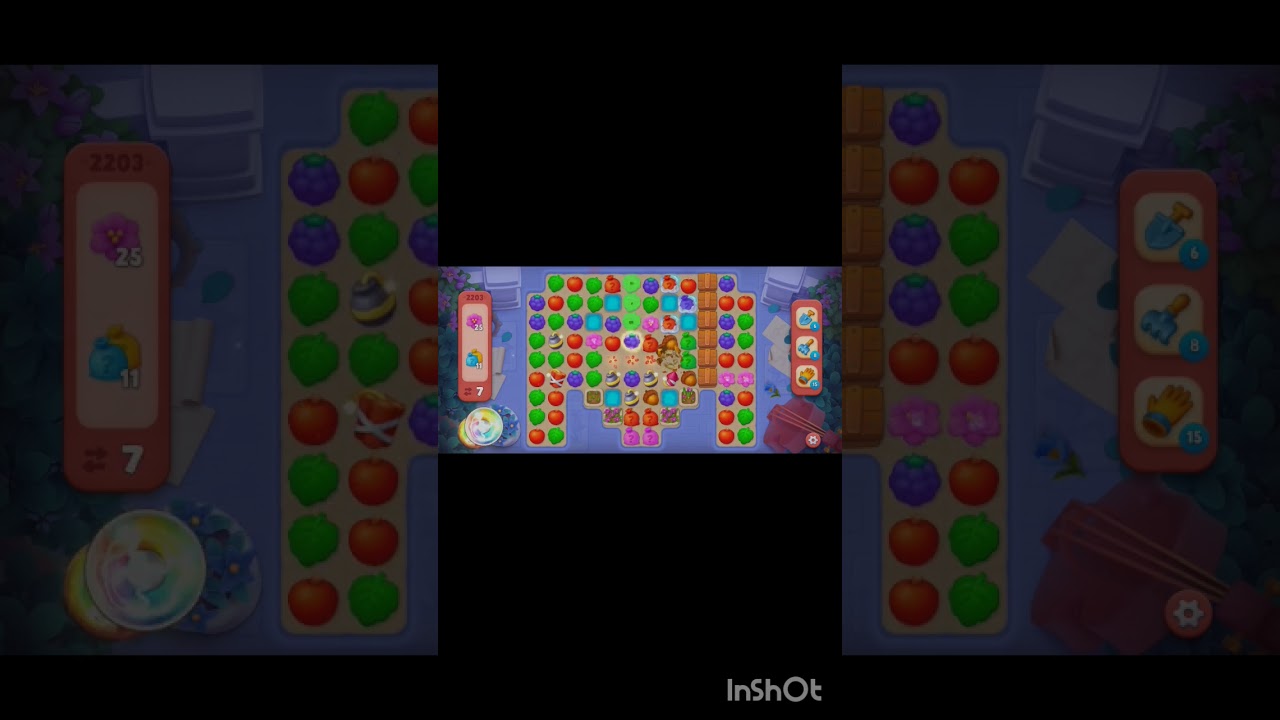
To beat Level 2203 in Gardenscapes, your first priority is destroying the dense blockers clustered in the center of the board. Shattering these central barriers expands your playable area and allows new pieces to drop from the top spawner tiles. Once the board opens up, stop making basic three-piece matches and focus entirely on assembling explosives, combining Rainbow Blasts, and triggering bottom-board cascades to clear remaining objectives within the move limit.
Step 1: Break Central Blockers to Open Board Lanes
The starting layout of Level 2203 restricts tile movement by walling off sections of the board with layered obstacles. While these obstacles remain intact, pieces cannot fall naturally through the central columns, severely limiting your ability to create power-ups.
- Target direct contact: Prioritize horizontal or vertical matches that touch the most fortified center blockers on your first few turns.
- Make adjacent shifts: If no direct match is available against the central barriers, make matches directly beneath them or in adjacent columns to realign the tiles.
- Ignore outer lanes: Do not waste moves matching along the outer edges early in the run unless the match triggers a cascade that damages central blockers.
Step 2: Form and Detonate High-Yield Explosives
Standard three-piece matches consume turns without generating the board-wide impact needed to win. Scan the grid before every turn to align four or more pieces into power-ups.
| Explosive | Tile Requirement | Radius and Strategic Function |
|---|---|---|
| Firecracker | 4 pieces in a straight line | Clears a 1-tile cross pattern; triggers nearby bombs or chips single obstacle layers. |
| Bomb | 5 pieces in a T-shape or L-shape | Clears a 3x3 area; ideal for dismantling dense central obstacle clusters. |
| Dynamite | 6 pieces in a line or bend | Clears a wide radius; resets stubborn sections of the board. |
| TNT Barrel | 7+ connected pieces | Clears a massive radius and rapidly fills the Rainbow Blast meter. |
Detonating Bombs and Dynamite in the lower-middle section of the board clears multiple blocker layers at once. This action creates open lanes, allowing cascading pieces to refill the board from above and create automatic combinations.
Step 3: Charge and Combine Rainbow Blasts
Detonating explosives charges the Rainbow Blast meter. Basic matches take too many turns to fill this gauge, so chained detonations are required to generate multiple Rainbow Blasts throughout the level.
The Double Rainbow Blast Combo
If two Rainbow Blasts drop next to each other, do not trigger them separately. Swapping two adjacent Rainbow Blasts clears the entire screen, stripping one layer from every destructible obstacle on the board and collecting all visible target pieces simultaneously.
Single Rainbow Blast Targeting
When you cannot pair two Rainbow Blasts, identify the piece color that anchors the thickest remaining obstacles. Activating the Rainbow Blast on that dominant color removes every matching piece across the entire board, opening space for secondary cascades and explosive drops.
Step 4: Work the Lower Board for Endgame Cleanup
Making matches near the bottom of the board causes all columns above to shift downward. This natural drop frequently triggers automatic chain reactions, cracking obstacles and creating unassisted power-ups without draining your move count.
As your move counter enters single digits, apply these finishing rules:
- Stop taking speculative matches: Calculate whether a move directly damages an objective or creates a guaranteed explosive.
- Handle isolated targets: Corner and edge objectives rarely clear through accidental cascades. Use Firecrackers or line-clearing power-ups to hit peripheral tiles directly.
- Target adjacent colors: If you have a single Rainbow Blast remaining during the final turns, swap it with the color immediately adjacent to your stranded objective to ensure a direct hit before moves expire.
Free Gardenscapes Codes
Current active codes and how to redeem them.

Emily Johnson
Emily writes practical mobile strategy guides with a focus on resource planning, base progression, and the early decisions that shape a long-term account.
COMMUNITY
Player Comments
59 players commented on this guide.
The explanation is clear, especially for beginners.
Nice guide. I am checking the other Gardenscapes articles next.
The tips are practical and easy to follow.
I tried this today and it worked better than my old setup.