
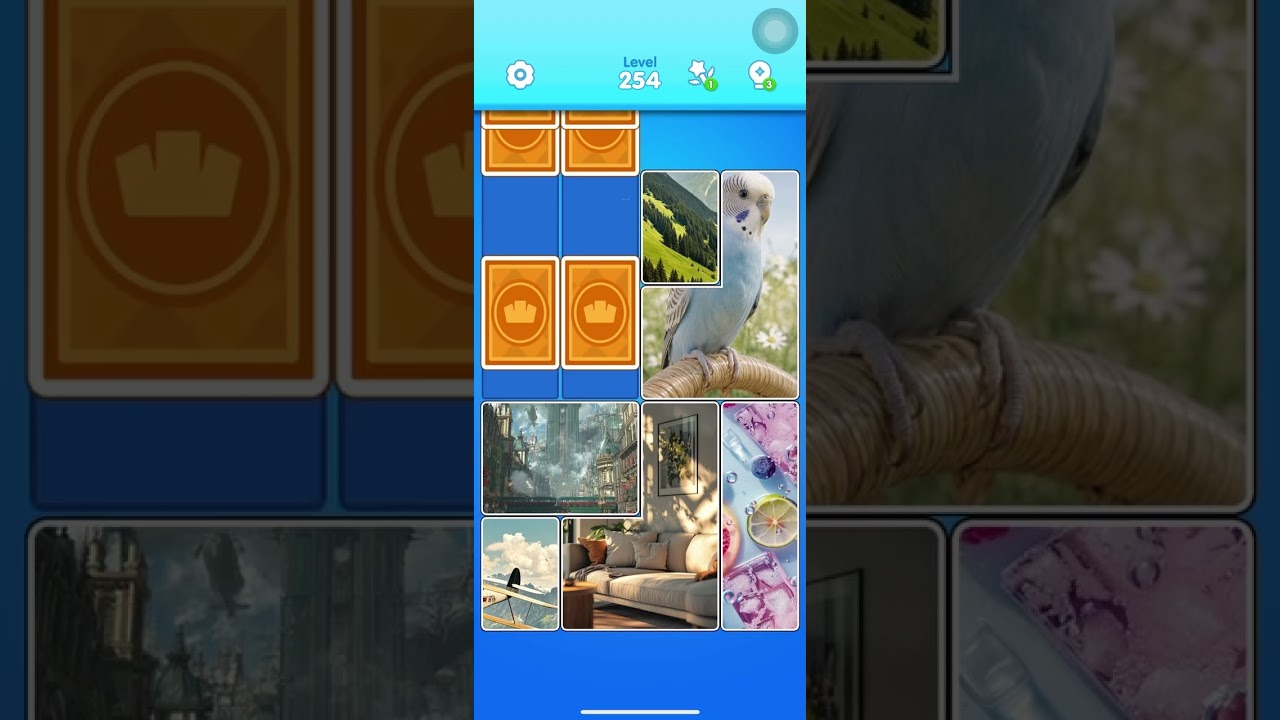
Levels 253, 254, and 255 in Jigsaw Drop: Solitaire Puzzle represent a significant difficulty spike, transitioning from standard puzzle-solving to high-stakes board management. At this stage, the game’s dynamic falling tile system becomes less forgiving, and the margin for error narrows substantially. To clear these levels, you must move beyond simple matching and adopt a disciplined strategy focused on preventing board saturation, identifying bottleneck pieces, and maximizing the utility of every move.
The Core Mechanic: Managing Board Saturation
The primary reason players fail in levels 253–255 is board congestion. When the board reaches a state of near-saturation, the game’s physics-based falling mechanics become restricted, effectively choking your ability to place new pieces.
In these levels, the board is designed to trick you into focusing on "easy" matches near the top. However, leaving deep, unmanaged columns is a recipe for a "dead board" state. To succeed, you must adopt a bottom-up clearing philosophy. By systematically working to lower the tallest columns first, you ensure that the "drop zone" remains open for incoming pieces. If a column reaches beyond the halfway point of your screen, it should immediately become your highest priority, regardless of whether a more attractive, easier match exists elsewhere on the board.
Identifying and Eliminating Bottlenecks
Every level in this sequence features "bottleneck" cards—specific tiles that act as keystones for the entire column’s structure. These are often buried beneath two or three layers of filler pieces.
A common mistake is burning moves on surface-level matches that do not expose these bottlenecks. To effectively clear these levels:
- Scan for the Keystones: Look for the card at the base of a tall stack that, once removed, will trigger a collapse or clear the most space.
- Sacrificial Clearing: If you must clear a few "useless" cards to reach a bottleneck, do it early. Do not wait until the late-game phase when your move count is critical.
- Evaluate the Risk: Ask yourself: "Does this move provide immediate value, or does it merely delay the inevitable?" If it doesn’t lower a stack height or clear a line, it is likely a wasted move.
Strategic Timing and Pattern Recognition
While Jigsaw Drop: Solitaire Puzzle is a relaxing game, levels 253–255 require a shift toward tactical deliberation. The visual complexity of the pieces is intentionally high, which can distract you from the underlying grid patterns.
- The Two-Second Rule: Before placing any piece, force yourself to wait two seconds. Use this time to scan the entire board for potential cascading clears—moves where one placement removes multiple lines.
- Anticipate the Queue: Always look at the next piece in your queue. If the upcoming piece is a "utility" card (a wildcard or a piece that fits into multiple gaps), save it. Do not waste a high-value piece on a low-impact move just because it’s available.
- Cascading Potential: Look for intersections. The best moves in these levels are those that clear a row and a column simultaneously. When you find these, prioritize them, as they effectively "reset" the board's density pressure.
Navigating the Progressive Difficulty of Levels 253–255
The difficulty curve from 253 to 255 is not linear; it is an escalation of constraints.
- Level 253 serves as a baseline check. It tests your ability to maintain board height. If you clear columns evenly here, you will pass.
- Level 254 introduces more restricted placement areas. You will find fewer "easy" spots, meaning you must be more precise with your drops.
- Level 255 is the culmination, where the game introduces "rigid" segments—fixed pieces that do not move and act as permanent obstacles.
When you reach Level 255, your strategy must transition to spatial optimization. Treat the rigid pieces as walls. You cannot clear them, so you must build your matches around them. Use the space adjacent to these fixed obstacles to clear your remaining dynamic pieces. If you try to force a move that doesn't fit logically around these obstacles, you will find yourself out of moves before the board is clear.
Common Mistakes to Avoid
Even experienced players often fall into these traps during the mid-to-late level sequence:
- The "Surface Trap": Focusing only on the top rows. This leads to massive, unmanageable piles in the lower sections of the board. Always clear from the bottom whenever possible.
- Ignoring the Queue: Placing a piece immediately without checking what is coming next. This often leaves you with a "dead drop"—a piece that has no viable slot on the board.
- Over-relying on Luck: Assuming the next drop will clear your mess. In these levels, the game is designed to provide pieces that challenge your current layout. Plan for the worst-case scenario, not the best.
Final Strategies for Success
To master these levels, you must accept that sometimes you will have to make a "suboptimal" move to prevent a total board lock. The goal is not always to clear the most cards in one go, but to keep the board fluid.
Summary Checklist for Every Move:
- Check Height: Is any column reaching the "Danger Zone" (top 25% of the board)? If yes, clear it immediately.
- Check Bottlenecks: Can I reach a key card that will collapse a large stack?
- Check the Queue: Does my current move render my next piece unusable?
- Check for Cascades: Can I clear two lines with one move?
By applying this rigorous decision-making process, you will find that levels 253–255 in Jigsaw Drop: Solitaire Puzzle become far more manageable. These stages are not tests of speed, but tests of logic and discipline. Focus on maintaining a clean board, anticipate the requirements of your upcoming pieces, and you will navigate through these difficult hurdles to reach the next set of puzzles with ease.

Free Jigsaw Drop: Solitaire Puzzle Codes
Current active codes and how to redeem them.

Sarah Williams
Sarah specializes in RPG and collection games, explaining team building, character growth, and beginner-friendly ways to avoid expensive early mistakes.
COMMUNITY
Player Comments
63 players commented on this guide.
This saved me time in the early game.
I tried this today and it worked better than my old setup.
I wish I had read this before upgrading the wrong thing.
Nice guide. I am checking the other Jigsaw Drop: Solitaire Puzzle articles next.