
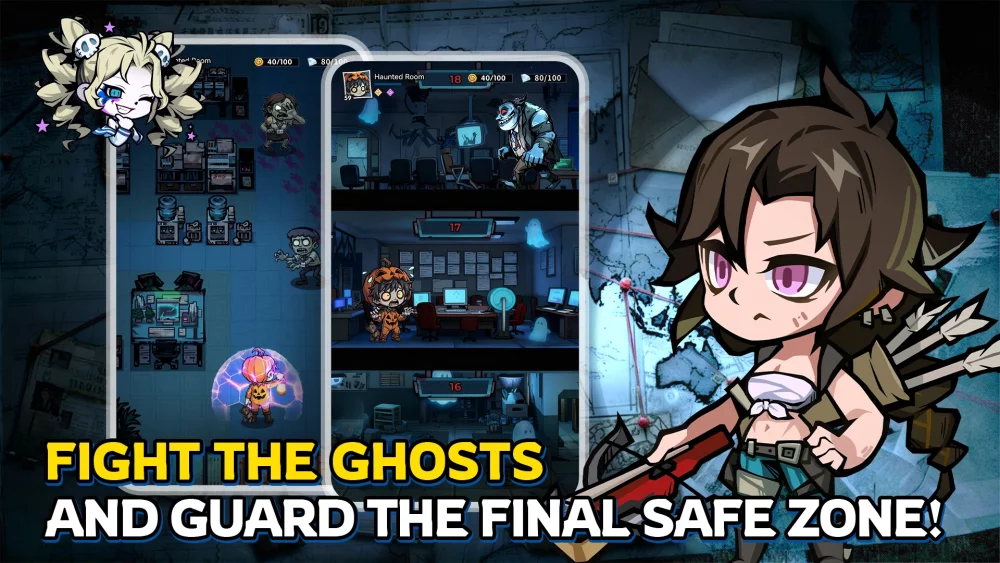
Clearing stages 188 through 200 in Knock Knock: Room Defense represents a significant plateau in progression where standard defensive strategies no longer suffice. At this stage, the game shifts from simple door maintenance to complex resource management and precise tactical execution. To survive, you must transition from reactive play to proactive optimization, balancing your economic engine against the increasing lethality of late-game ghost waves.
The Economic Foundation: Scaling for Late-Stage Survival
In the high-level stages of Knock Knock: Room Defense, your gold-per-second (GPS) is your most valuable weapon. If your economic growth lags behind the enemy's scaling, your defense will inevitably crumble regardless of your turret quality.
- Prioritize Bed Upgrades: Your bed is the heart of your economy. During the first 60 seconds, ignore luxury defensive structures and pour every coin into bed upgrades to maximize your passive income.
- The "Buffer" Strategy: Maintain a gold reserve that allows for at least two emergency door repairs. Spending your last coin on a turret only to have the door breached a second later is a common mistake that leads to failure.
- Optimal Generator Placement: Not all grid squares are created equal. Prioritize placing your highest-tier generators in squares that are furthest from the door or behind your strongest defensive walls to ensure they remain functional even during minor breaches.
Tactical Hero Positioning and Ability Management
Hero utility is the primary differentiator between a stalled run and a successful clear. Between stages 188 and 200, hero placement should be dictated by enemy pathing and crowd control (CC) requirements.
- Lane Locking: Place heroes with high attack speed or CC capabilities near the primary entry points. This forces ghosts to cluster, making them easier targets for your AOE (Area of Effect) turrets.
- Ability Cycling: Do not fire all your hero ultimates at the start of a wave. Instead, use them as "staggering" tools. If a boss ghost is hitting your door, wait for the door's health to drop to 40% before popping a defensive ultimate to maximize the value of the damage mitigation.
- Hero Synergy: Pair heroes who provide passive buffs to turret attack speed with those that debuff ghost armor. This multiplication effect is essential for melting high-HP bosses that appear in the final waves of these stages.
Surviving the "Ten Thousand Ghosts" Mechanic
The "Ten Thousand Ghosts" (Wan Gui) event is the ultimate test of your defensive setup. This stage introduces a density of enemies that can overwhelm even the best turrets if you are not prepared for the surge.
- Resource Hoarding: You must enter the "Ten Thousand Ghosts" phase with a significant gold cushion. Do not spend everything on max-level turrets before the event starts; you need liquid cash to perform rapid repairs while the swarm is at its peak.
- The "Spring of Sacrifice" (Ji Quan) Sync: The Ji Quan mechanic is designed to be your lifeline. Align your usage of the Spring of Sacrifice with the moments where your turret fire rate is insufficient to handle the swarm density. Using this boost too early is a common cause of late-run failure.
- Prioritizing Integrity: During this event, if your door health is below 50%, stop building new turrets. The cost-to-benefit ratio of a new turret is negated if the room is breached. Focus entirely on maintaining structural integrity until the swarm thins.
Advanced Defensive Layouts: When to Pivot
As you reach stage 200, you will encounter difficulty spikes that make early-game defensive items obsolete. A common mistake is clinging to low-tier turrets simply because they are already upgraded.
- The Upgrade-or-Replace Threshold: If a low-tier turret is not contributing at least 15% to your total damage output, it is effectively dead weight. Don't hesitate to sell it to fund the construction of a high-tier, specialized defensive structure.
- Boss-Specific Defenses: By stage 190+, you should be identifying the boss patterns. If you are facing a high-HP ghost, pivot your layout to include single-target "sniping" turrets. If you are facing a swarm, pivot to AOE.
- The Dawn Timer: Always keep an eye on the "Dawn" clock. In the final 30 seconds of a stage, ignore gold collection if it puts your door at risk. Defensive survival at this stage is binary—it does not matter how much gold you have left over if the door falls before the timer hits zero.
Common Pitfalls and How to Avoid Them
Even experienced players often hit a wall at stage 188. Here are the most frequent mistakes observed in high-level gameplay:
- Over-Building: Placing too many low-level turrets clutters your board and limits your ability to place high-tier equipment later. Quality always beats quantity in the late game.
- Panic Repairs: Repairing the door too often consumes gold that could have been used for a game-winning upgrade. Learn the "damage threshold" of your door—how many hits it can take before you absolutely must repair.
- Ignoring Buffs: Failure to activate environmental buffs at the right time. Knock Knock: Room Defense is a game of timing; holding a buff for an extra 10 seconds to catch an incoming boss wave is often the difference between a win and a loss.
By strictly adhering to these economic and tactical principles, you will find that the difficulty spikes between stages 188 and 200 become manageable. Focus on your gold income, maintain your door integrity, and treat every hero ability as a strategic asset to be deployed, not just an automated feature.

Free Knock Knock: Room Defense Codes
Current active codes and how to redeem them.

Sarah Williams
Sarah specializes in RPG and collection games, explaining team building, character growth, and beginner-friendly ways to avoid expensive early mistakes.
COMMUNITY
Player Comments
112 players commented on this guide.
This helped me understand heroes much better.
I tried this today and it worked better than my old setup.
The tips are practical and easy to follow.
Nice guide. I am checking the other Knock Knock: Room Defense articles next.