
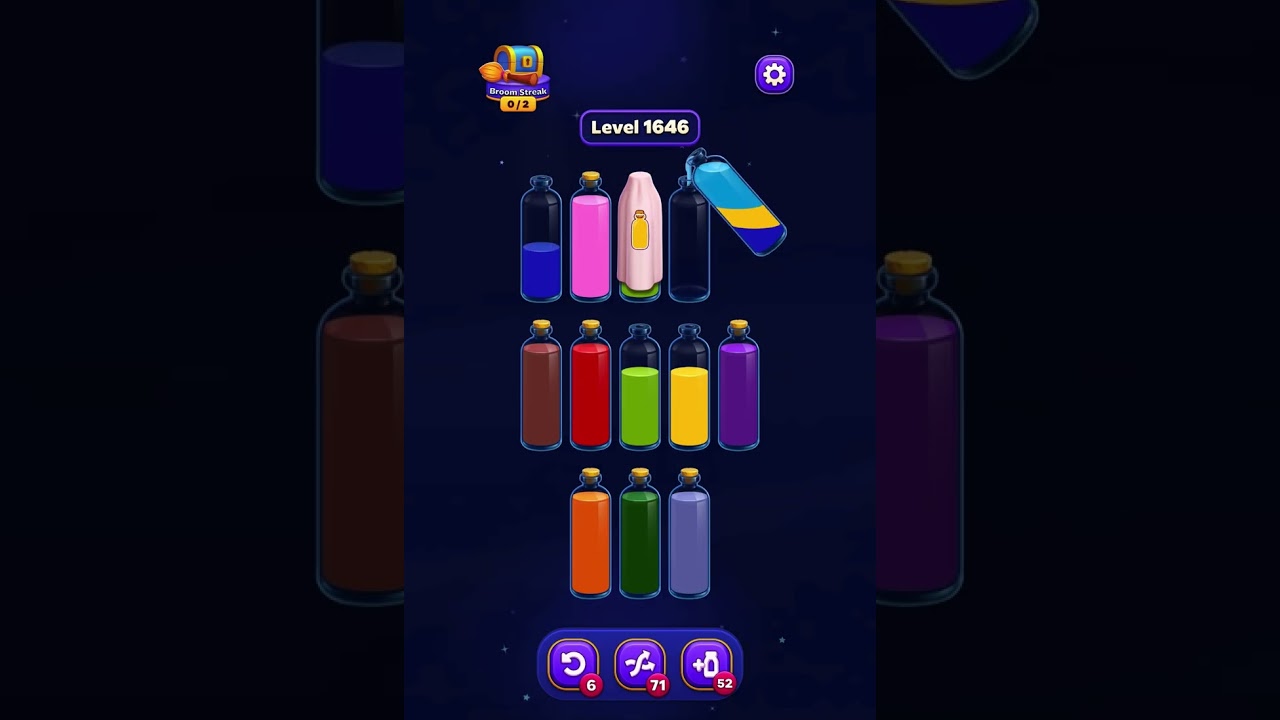
Mastering the late-game stages of Magic Sort! requires a fundamental shift from intuitive, reactionary play to a systematic, color-displacement methodology. Between levels 1641 and 1650, players encounter restricted vessel counts and complex color layering that demand surgical precision. At this stage of the game, a single misplaced pour can create a "deadlock"—a scenario where the board state becomes unsolvable without the use of power-ups.
To clear these high-difficulty puzzles, you must stop looking at individual moves and start analyzing the board as a flow-based system. By prioritizing the creation of empty vessels early and isolating singular colors, you can prevent gridlock and ensure that every pour contributes to a final, unified color state.
The Foundation of Success: Empty Vessel Creation
In the 1600-level range of Magic Sort!, the primary cause of failure is a lack of available "maneuvering space." When every bottle is partially filled, your ability to move colors is severely constrained.
Your objective during the first ten moves of any level from 1641 to 1650 should be the total clearance of at least one or two bottles. An empty vessel is not just a container; it is a buffer zone. It allows you to move "blocking" colors out of the way to reach deep-seated segments that are currently buried at the bottom of a stack. If you find yourself with zero empty bottles, you are likely forced into sub-optimal moves that mix colors further, compounding the difficulty. Always look for the bottle with the fewest distinct color layers and prioritize clearing that vessel entirely.
Isolate Base Colors to Simplify the Board
Levels 1641 through 1650 often feature "trapped" colors—colors located at the bottom of bottles—obscured by two or three different layers of contrasting hues. A common novice mistake is attempting to solve these bottom layers too early.
Instead, practice Color Isolation:
- Identify the Dominant Color: Find the color that appears most frequently across the board.
- Consolidate: Move these segments to the top of your available bottles or into a dedicated "anchor" bottle.
- Reduce Variables: By concentrating one color into a single container, you free up the other bottles it previously occupied.
When you treat the board as a collection of isolated color blocks rather than a chaotic mix of individual layers, you can predict which moves will unlock the next layer of the puzzle without triggering a cascade of mixed colors.
Managing Multi-Layered Color Conflicts
The core challenge in the 1640s is managing bottles containing three or more colors. If you have a bottle with a top layer that matches a layer in a different, semi-empty bottle, clear that layer immediately to expose the color beneath it.
Avoid the trap of "moving just to move." If you cannot make a move that either completes a color or exposes a new color, you are likely approaching the level incorrectly. In these instances, it is often more efficient to reset the level than to waste moves on shuffling. Often, the sequence of the first three moves determines whether you will have enough space for the final, more complex sorting stages. If your opening moves result in a "locked" state where you cannot expose a new color, restart the level and test a different sequence.
Strategic Use of Magic Tools
When encountering the heightened difficulty of levels like 1648 or 1650, do not be afraid to use the built-in assistance tools provided by Magic Sort!. However, these should be treated as tactical solutions, not crutches.
- The Undo Function: Use this immediately if you accidentally pour a color into a bottle that creates an irreversible mixed-stack. If you see a move is about to be a mistake, undo it before the animation finishes to maintain your momentum.
- The Extra Bottle: This is the most efficient way to break a deadlock in levels where the layout provides only the bare minimum number of vessels. If you have identified a specific "bottleneck" move—where a color is trapped behind two others—the extra bottle provides the necessary space to swap those colors effectively.
- Resource Management: Do not use coins to brute-force the entire level. Save them for the final 20% of the puzzle. Most levels in this range have a "tipping point" where the majority of the colors are sorted; once you reach this, the remaining moves become trivial.
Optimizing for Efficiency and Consistency
As you progress through levels 1641–1650, aim for the fewest number of pours possible. While Magic Sort! does not always impose a strict timer, the game tracks your move efficiency. High-level play is defined by identifying which color is an "anchor" and which is merely "transitional."
The Top-Down Clearing Strategy: Always focus on clearing the top layer of colors that are already present elsewhere on the board. This creates a chain reaction:
- Clear a top layer.
- The bottle below it is now exposed.
- If that exposed color matches another bottle, you can immediately move it.
- This keeps your moves linked, preventing the board from becoming cluttered with small, unmovable slivers of color.
By applying this top-down methodology, you maintain consistency across the entire 1641–1650 block. You will find that you spend less time shuffling colors between the same three bottles and more time resolving the puzzle. Remember, in Magic Sort!, the board is a puzzle of space management as much as it is a puzzle of color matching. If you keep your vessels clean and your colors isolated, you will clear these levels with ease.

Free Magic Sort! Codes
Current active codes and how to redeem them.

Emily Johnson
Emily writes practical mobile strategy guides with a focus on resource planning, base progression, and the early decisions that shape a long-term account.
COMMUNITY
Player Comments
117 players commented on this guide.
Good guide for Magic Sort! players. The base building part was useful.
Can you add more details about base building in a future update?
This helped me understand base building much better.
This saved me time in the early game.