
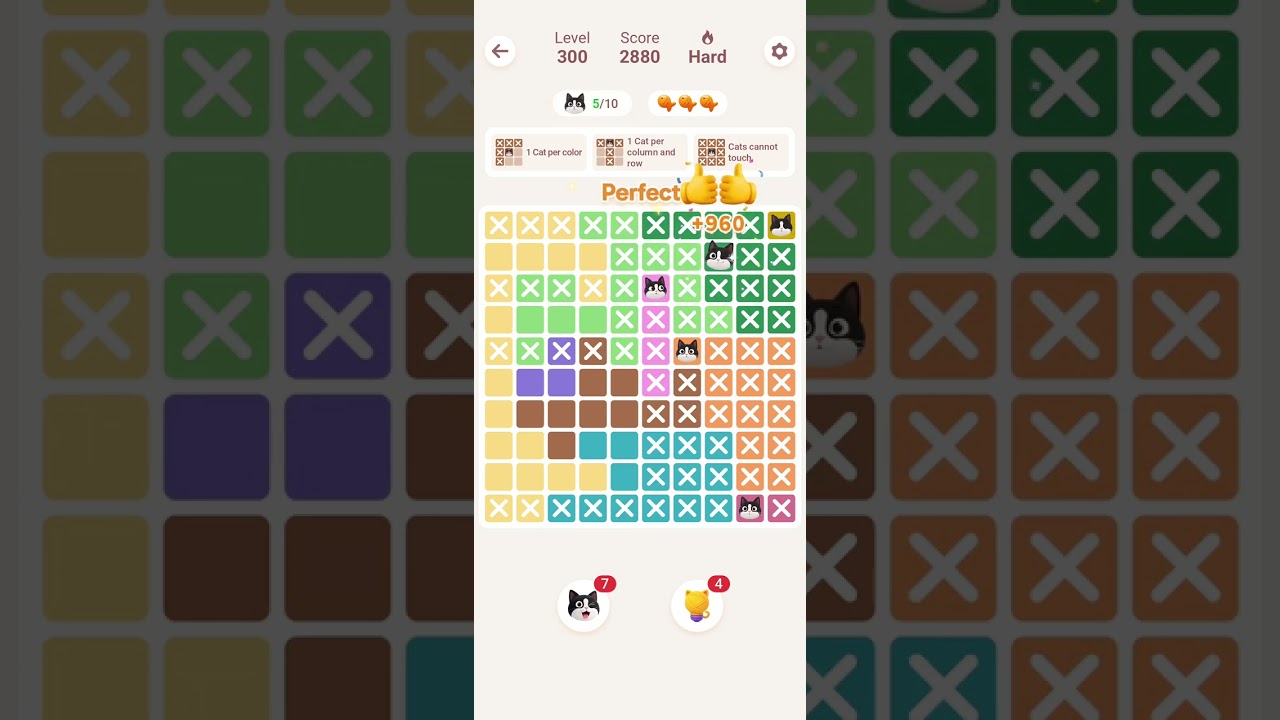
Solving Level 300 in Meowdoku! represents a significant jump in difficulty, requiring players to move beyond basic pattern recognition and adopt a rigorous, analytical mindset. Because Meowdoku! blends the structural requirements of Sudoku with the deduction-based "mine-clearing" mechanics of Minesweeper, a single misstep in a high-density level can cascade into an unsolvable board.
To clear Level 300, you must stop viewing the grid as a collection of squares and start viewing it as a web of intersecting constraints. This guide provides the tactical framework needed to navigate this challenging stage without resorting to trial-and-error.
The Core Logic of Meowdoku! Level 300
At its heart, Level 300 is a test of your ability to identify "forced moves." In lower levels, you can often solve cells through simple elimination. In Level 300, the board is intentionally sparse in critical areas, forcing you to use the "Minesweeper" aspect of the game—deducing where cats cannot be—to unlock the "Sudoku" aspect of placing digits.
The primary goal is to maintain a perfect streak while navigating the high-density center. If you find yourself guessing, you have likely missed a constraint in the periphery.
Step 1: Identifying Fixed Constraints via Sweeping Scans
The most effective opening move for Level 300 is a "sweeping scan." Instead of trying to solve a specific row, scan the entire board for any digit that appears in more than 50% of the possible lanes.
- Anchor Points: Identify digits that have only one or two valid spots across the entire board. These are your anchor points.
- The 50% Rule: If a number is already placed in four out of nine rows, focus on the remaining five. The interplay between these remaining cells is often where the first breakthrough occurs.
- Cross-Reference: Always verify if a proposed placement in a row creates a conflict in the intersecting column or the sub-grid. In high-level Meowdoku!, the most common mistake is focusing on row logic while ignoring the column-based restrictions that the game’s Minesweeper mechanics impose.
Step 2: Leveraging Elimination to Narrow Down Options
Once the obvious placements are filled, you will inevitably reach a point where multiple cells have ambiguous candidates. This is where you switch to Negative Deduction.
Instead of asking, "What goes here?", ask, "What cannot go here?"
- Exclusion: Look at a cell and list every number currently present in its row, column, and sub-grid.
- Candidate Thinning: If a cell has only two potential candidates, look at the neighboring cells. If one of those candidates is required elsewhere in that sub-grid, you have logically forced the placement.
- The "Hidden Single" Technique: Even in dense grids, there is often one cell in a house (row, column, or square) that can only hold one specific number, even if that cell initially appears to have multiple candidates. Finding these "hidden singles" is the primary way to break through the mid-game of Level 300.
Step 3: Managing the Risk of Logical Deadlocks
A deadlock in Meowdoku! occurs when you have placed digits that are technically legal but mathematically impossible to complete. This is the "cascade failure" that Level 300 is designed to trigger.
- The "Undo" Discipline: Do not fear the undo button. If a section of the board refuses to resolve, do not force a placement. It is almost certain that a digit placed three or four moves ago is slightly misaligned.
- Sector Hopping: If a specific quadrant feels blocked, leave it. Move to the opposite side of the board. Often, the logic required to solve the bottom-right quadrant is hidden in the constraints of the top-left quadrant.
- Avoid Assumption Chains: Never commit to a move based on a "feeling." If you cannot prove a placement is correct through a direct rule violation of other candidates, do not place it.
Step 4: Sequencing Moves for Efficiency
Efficiency is the key to minimizing mistakes. The order in which you solve the board determines how much information you have at your disposal.
- High-Population Lanes: Always solve rows and columns with the most pre-filled cells first. These are the "low-hanging fruit" that define the board’s geometry.
- Corner Intersections: Once the high-population lanes are clear, focus on the corners. Corners are the most constrained cells in any Meowdoku! grid because they belong to the fewest number of intersecting lines compared to center cells.
- Center Density: Save the center of the board for last. The center is where the most variables interact; by solving the perimeter first, you shrink the number of variables, making the center significantly easier to solve by default.
Common Mistakes to Avoid
- Tunnel Vision: Don't focus on a single sub-grid for too long. If you've spent more than two minutes on one 3x3 box without a placement, you are likely missing a constraint that originates from outside that box.
- Ignoring the "Minesweeper" Rules: Remember that Meowdoku! isn't just Sudoku. If the game mechanics imply a restricted area due to "cat" placement logic, respect those boundaries as strictly as you would a row of numbers.
- Over-reliance on Trial-and-Error: The game is designed so that every level is solvable through pure logic. If you are guessing, you are not playing the game as intended; you are gambling.
Final Summary of Tactics
To conquer Level 300, treat the grid as a puzzle that yields to patience. Start with the most populated lines, utilize negative deduction to prune impossible candidates, and use the "undo" feature as a diagnostic tool rather than a safety net. By following this systematic approach, you will transform the overwhelming complexity of Level 300 into a series of manageable, logical steps. Keep your notes clean, your focus high, and always prioritize certainty over speed.

Free Meowdoku! Codes
Current active codes and how to redeem them.

Sarah Williams
Sarah specializes in RPG and collection games, explaining team building, character growth, and beginner-friendly ways to avoid expensive early mistakes.
COMMUNITY
Player Comments
24 players commented on this guide.
I tried this today and it worked better than my old setup.
The explanation is clear, especially for beginners.
This helped me understand strategy much better.
The tips are practical and easy to follow.