
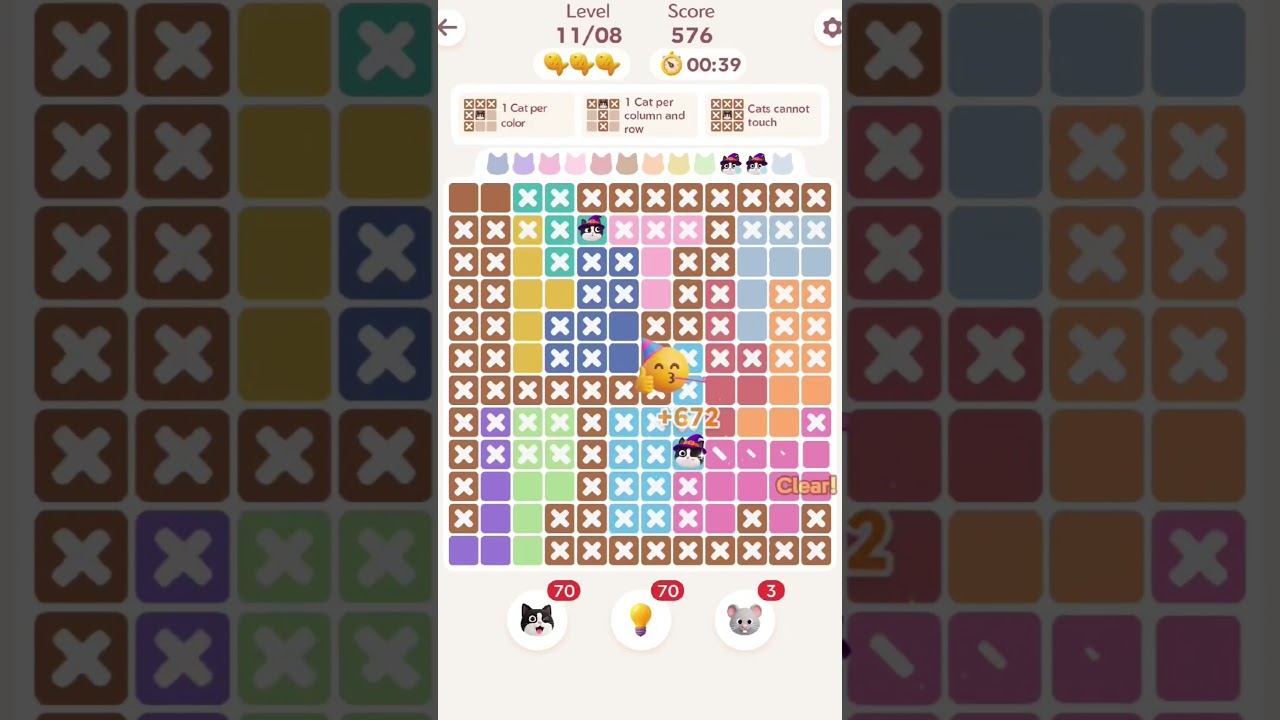
To solve the Meowdoku!! November 8 daily puzzle without exhausting mistake counters, prioritize defensive cell eliminations in tightly constrained color regions before confirming any cat positions. Identifying zones confined to a single row or column lets you immediately rule out invalid tiles, safeguard neighboring territories, and reveal guaranteed placements.
Core Rules and Constraints
Every valid solution on the November 8 grid must satisfy four non-negotiable placement conditions simultaneously:
- Row Quota: Exactly one cat per row.
- Column Quota: Exactly one cat per column.
- Territory Quota: Exactly one cat inside each distinct color zone.
- Adjacency Restriction: No two cats may touch horizontally, vertically, or diagonally.
Placing a cat immediately marks all eight surrounding squares as illegal. Because territories interlock across the grid, an unverified placement can trigger an invalid cascade across neighboring regions. Treat every unconfirmed square as an elimination candidate: place an X wherever a theoretical cat would deprive an adjacent zone of its only valid move.
Early-Game Line and Boundary Deductions
Begin by scanning the board for color zones that span only a single row, a single column, or a narrow two-line band. Because that zone must contain its designated cat within that narrow strip, the corresponding line cannot hold a cat anywhere else.
Use these deduction steps to clear exterior tiles without guessing:
- Clear Line-Locked Zones: If every square of a color territory sits in the same row or column, mark an X on every cell outside that territory along that entire line.
- Evaluate Parallel Slices: When two neighboring regions are mutually confined to two parallel lines, eliminate candidate tiles in those two lines for all other overlapping zones.
- Cross Out Conflicted Protrusions: If an individual cell projects into an adjacent zone such that occupying it would eliminate all legal options for that neighbor, mark that cell with an X immediately.
Structural Elimination Patterns
Evaluating cell shapes and corner geometry allows you to safely eliminate options before committing cats to the board.
| Grid Pattern | Structural Constraint | Recommended Action |
|---|---|---|
| Three-Cell Line | Center cell covers adjacent border tiles on both sides | Mark the center with an X if neighboring zones require border space |
| L-Shape Corner | Inner corner projects diagonal blocks into bordering zones | Mark an X if occupying the corner starves an adjacent color region |
| Two-Cell Squeeze | Both cells project overlapping diagonal coverage | Cross out external cells that touch both candidate options |
| Perimeter Edge | Edge tiles share fewer neighbors but consume row/column quotas | Test edge placements to satisfy boundary lines while protecting crowded centers |
Placement Cascade and Endgame Verification
Once defensive X marks remove competing candidates, single-square options will open across the grid. Progress through the remaining board systematically:
- Lock the Single Candidate: Place a cat into any color zone, row, or column reduced to one remaining legal tile.
- Apply the Full Footprint: Immediately mark an X across the cat's entire row, its entire column, and all eight surrounding adjacent squares.
- Scan for New Singletons: Check adjacent territories where the footprint just eliminated options, locking in any newly isolated squares.
- Conduct a Sector Audit: Before placing the final cats, count each row, column, and color zone to verify that every designated line contains exactly one cat and that no diagonal contact points exist. Tracing open lines across the last two candidate tiles will confirm the correct final position.

Free Meowdoku! Codes
Current active codes and how to redeem them.

Sarah Williams
Sarah specializes in RPG and collection games, explaining team building, character growth, and beginner-friendly ways to avoid expensive early mistakes.
COMMUNITY
Player Comments
101 players commented on this guide.
This guide answered the exact question I had.
I wish I had read this before upgrading the wrong thing.
The explanation is clear, especially for beginners.
Nice guide. I am checking the other Meowdoku! articles next.