
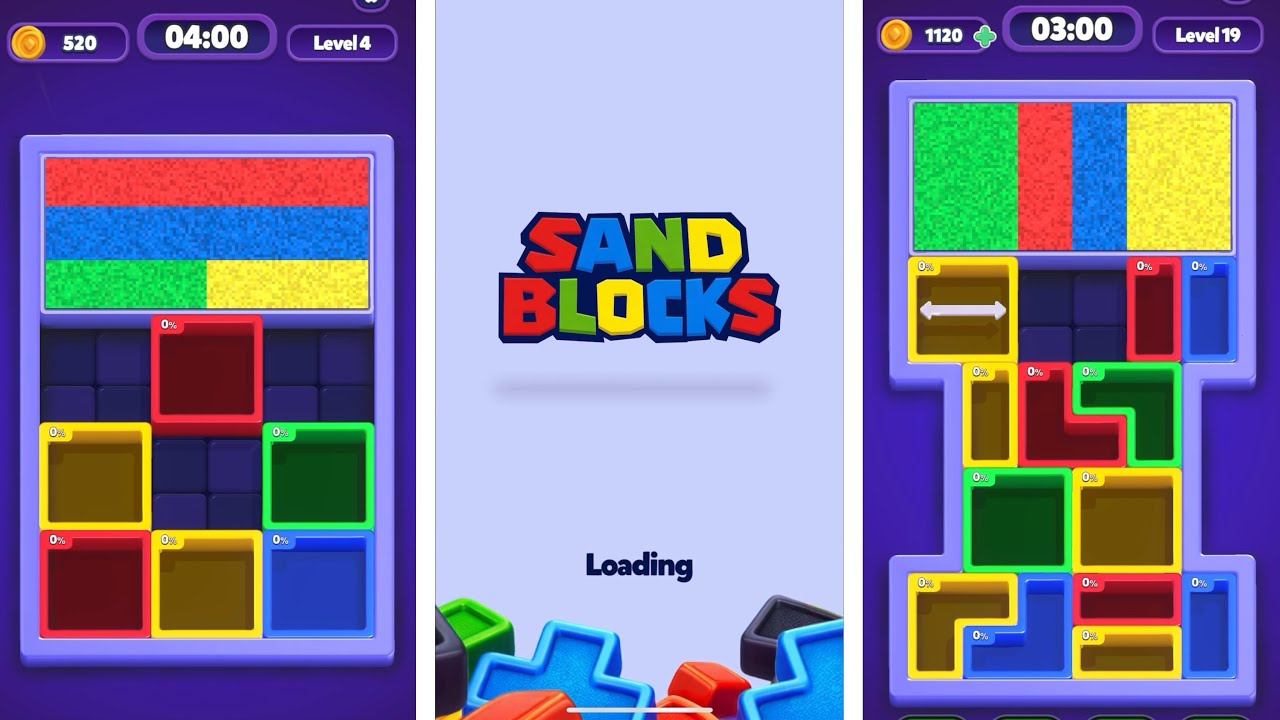
To clear Levels 1 through 20 in Sand Blocks: Drop Puzzle, create an unbroken horizontal band of a single color stretching from the left wall to the right wall. Rigid geometric blocks disintegrate into flowing sand grains upon impact. Maintaining a level board and preventing stray colors from contaminating incomplete layers are the primary requirements for clearing lines before the board fills up.
Core Sand Physics and Clear Rules
Every piece behaves as solid geometry while falling but dissolves into loose particles as soon as it touches the floor or an existing block. Grains tumble downward and outward along slopes into empty spaces until they settle.
A row clear only activates when matching colored sand connects uninterrupted across the entire width of the playfield. Mixing even a few grains of another color into that horizontal path interrupts the connection and prevents the clear.
| Mechanic | Behavior | Strategic Impact |
|---|---|---|
| Sand Collapse | Solid blocks break into loose grains on contact. | Fills pits and valleys automatically, but can slide into unintended columns. |
| Wall-to-Wall Clear | Requires a continuous, single-color horizontal band. | Contaminating a layer with an off-color halts the clear. |
| Color Stacking | Incoming sand settles over existing grains. | Builds elevation for higher clears, but traps unfinished colors below. |
Leveling the Board in Levels 1 to 10
Early stages focus on single-color clustering and board balance. Dropping vertical blocks into the middle of the board builds steep pyramids. Grains then slide uncontrollably toward the outer walls, leaving jagged pits that are difficult to bridge.
- Lay pieces flat: Orient multi-block pieces horizontally across the lowest empty areas to form an even base.
- Flatten central peaks: When a mound forms in the center, rotate a wide piece horizontally and drop it directly onto the crest. The impact forces the sand grains to slide down both flanks, filling deep valleys along the borders.
- Distribute run-off: Drop incoming shapes close to narrow gaps so crumbling sand rolls inward to fill the holes.
Managing Multiple Colors in Levels 11 to 20
Stages 11 through 20 introduce alternating colors. Placing a new color directly onto an incomplete layer of a different color traps the lower sand. You cannot clear the trapped material until the entire top layer is eliminated.
Follow this sequence to keep multi-color boards manageable:
- Check the bottom layer: Identify the dominant color on the floor and prioritize drops of that matching color to clear the lowest row first.
- Bank off-colors in corners: If a piece does not match the active floor layer, rotate and drop it against the far left or right wall away from your primary clearing lane.
- Group shared colors by side: When you cannot form a full horizontal line immediately, place matching colors on one side of the playfield and wait for subsequent matching pieces to bridge the remaining half.
- Prevent thin surface coats: Avoid spreading stray colors across the entire width of the board, as a thin conflicting layer disables all clears directly beneath it.
Recovering from a High Board
When the sand stack approaches the top boundary line, abandon attempts to set up multi-row combinations. Focus entirely on rapid, single-layer clears to reduce board height.
Look for the color layer with the widest horizontal coverage, even if it sits near the top of the pile. Drop matching pieces directly into the remaining gaps of that band. Clearing a top layer removes immediate ceiling pressure and allows trapped blocks to fall. Clearing a deeper layer triggers a larger downward collapse, which often shifts the upper sand into open valleys and levels out the board.
Free Sand Blocks: Drop Puzzle Codes
Current active codes and how to redeem them.

James Brown
James focuses on Android gaming on PC, emulator setup, controls, performance tuning, and practical troubleshooting for longer play sessions.
COMMUNITY
Player Comments
144 players commented on this guide.
I wish I had read this before upgrading the wrong thing.
Nice guide. I am checking the other Sand Blocks: Drop Puzzle articles next.
This saved me time in the early game.
The explanation is clear, especially for beginners.