
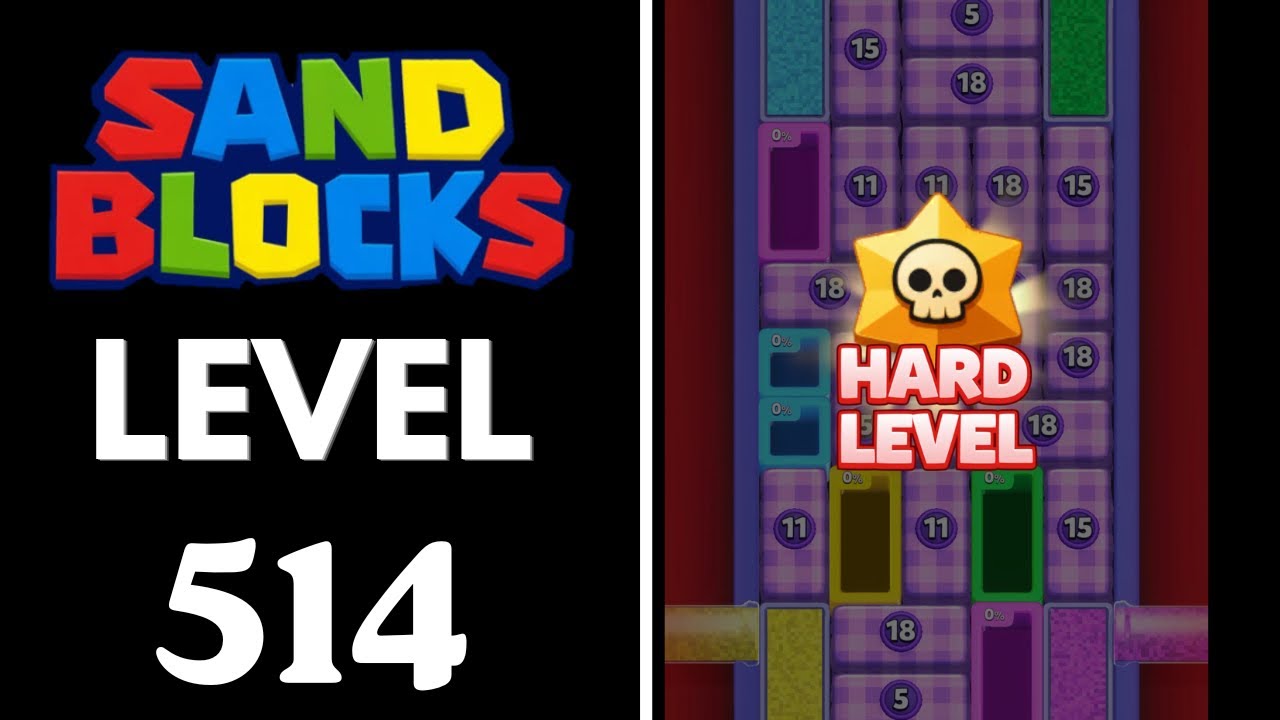
To beat Level 514 in Sand Blocks: Drop Puzzle, keep the sand surface flat and low while completing unbroken, single-color bands from the left wall to the right wall. Pieces enter the board as rigid geometric shapes but dissolve into fluid sand grains upon landing. To prevent sand from reaching the upper boundary ceiling, prioritize filling deep depressions, isolating mismatched colors against side walls, and committing pieces to whichever color line is closest to completion.
Core Objective and Win Conditions
Clearing Level 514 requires connecting a single color continuously across the full width of the playfield. When an unbroken ribbon of matching sand touches both the left and right boundary walls, the entire band dissolves, granting score progress and dropping overhead sand downward.
The primary fail condition is accumulation: if unsettled sand stacks high enough to breach the top ceiling line, the run ends immediately. Because granules roll down inclines and pool into open crevices, standard block-stacking logic fails. Every placement must account for where loose grains slide after the initial block dissolves.
Managing Color Segregation
A single stray granule of a contrasting color wedged inside an active lane prevents the game engine from recognizing an edge-to-edge connection. Keeping colors segregated into dedicated sections prevents fragmented layers that stall your progress.
When an incoming block does not match the horizontal band currently under construction, redirect it away from the center. Depositing off-color sand against an outer wall preserves the clean floor space needed for your primary line.
| Drop Placement | Sand Behavior | Tactical Purpose in Level 514 |
|---|---|---|
| Wall-Anchoring Drop | Granules bank against the wall, creating an inward ramp | Isolates off-color pieces away from active horizontal clear paths |
| Central Valley Drop | Granules settle into low crevices, evening the terrain | Smooths jagged peaks to create a level base for line clears |
| Layered Flat Drop | Horizontal shapes spread across a wide horizontal plane | Bridges gaps quickly to finalize a full left-to-right connection |
Step-by-Step Drop Priority
Targeting low valleys rather than existing peaks is the most reliable way to build clean horizontal lines without triggering premature overflows.
- Rotate shapes at the ceiling: Orient blocks before releasing them downward. Aligning a wide, flat profile parallel to the floor spreads grains across a broader width and prevents steep spires from forming.
- Fill deep depressions first: Direct pieces into the lowest valleys on the board. Flattening terrain creates a stable, level foundation for subsequent color ribbons.
- Commit to advanced color bridges: When a single color spans more than half the board, commit all incoming matching shapes to finishing that specific line. Splitting drops between multiple colors clogs the playfield and leaves competing rows unfinished.
- Pause for post-clear settling: After completing a line clear, observe how remaining overhead grains collapse into the cleared space. Gravity naturally shifts overhead peaks into open low spots, revealing the best placement for your next piece.
Triggering Cascades and Ceiling Recovery
Clearing a low band causes every layer resting above it to drop under active physics. When matching sand sits directly above an active row, clearing the bottom row drops the upper grains into an even plane, frequently triggering an automatic cascade clear without expending extra moves.
If sand stacks near the danger line, enter emergency recovery mode immediately:
- Abandon long-term setups across secondary colors.
- Target the specific color that requires the fewest remaining grains to touch both walls.
- Clear a thin horizontal strip to collapse the entire sandbed downward, instantly eliminating ceiling pressure and restoring playable board space.
Common Mistakes to Avoid
- Creating tall central pyramids: Dropping pieces repeatedly down the center forms a steep dune that splits future blocks in half, scattering mismatched granules into both corners. Direct narrow pieces toward outer boundaries to maintain an even grade.
- Rotating near the sandbed: Spinning shapes while they descend through the lower board risks clipping high dunes, causing pieces to shatter early at unpredictable angles. Complete all rotations near the top boundary before committing to a drop column.
- Contaminating near-finished rows: Placing contrasting blocks directly above an incomplete color band buries the open gap, forcing you to clear unnecessary overhead weight before you can finish the original line.
Free Sand Blocks: Drop Puzzle Codes
Current active codes and how to redeem them.

Emily Johnson
Emily writes practical mobile strategy guides with a focus on resource planning, base progression, and the early decisions that shape a long-term account.
COMMUNITY
Player Comments
130 players commented on this guide.
The explanation is clear, especially for beginners.
The tips are practical and easy to follow.
I tried this today and it worked better than my old setup.
Good guide for Sand Blocks: Drop Puzzle players. The strategy part was useful.